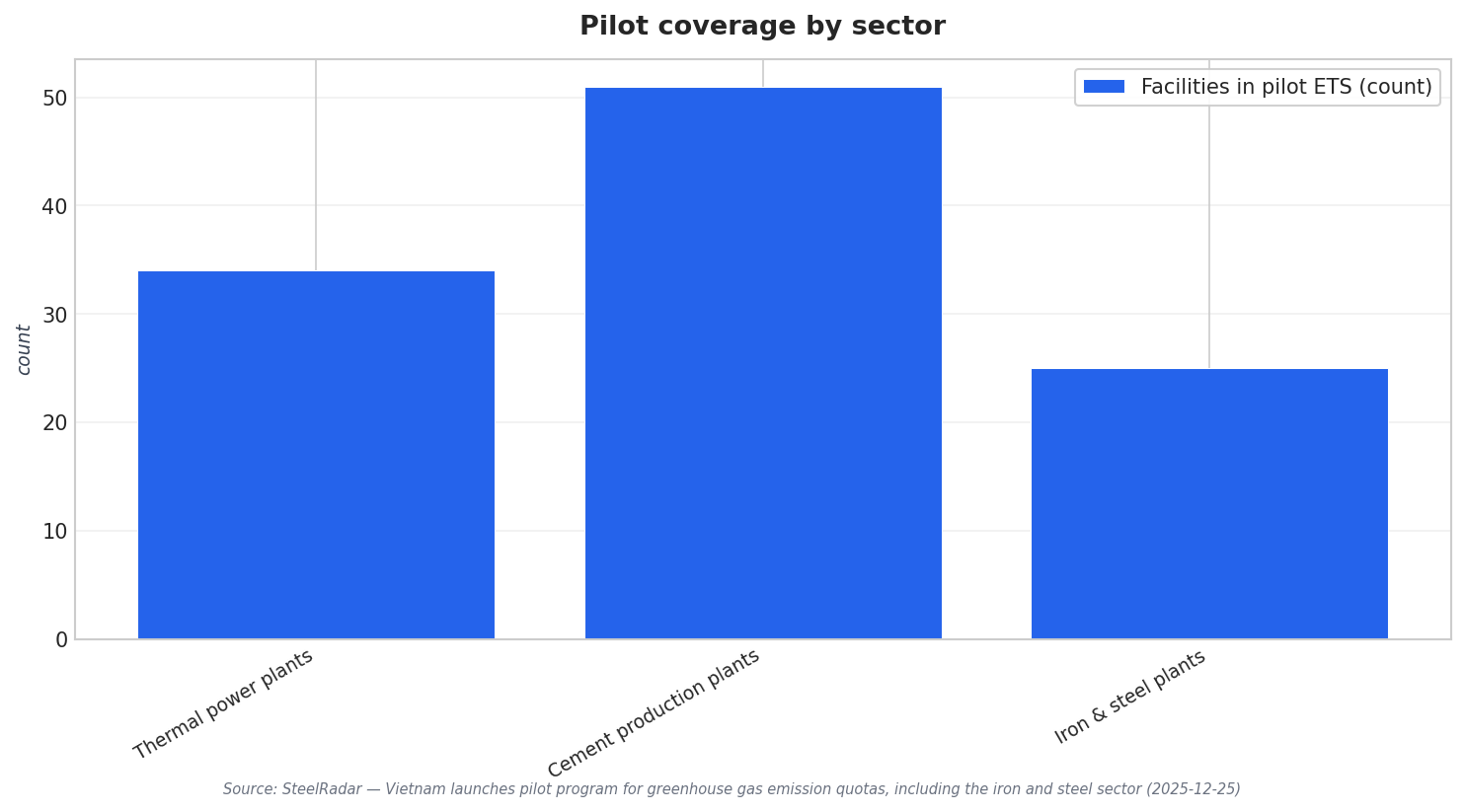
Vietnam’s pilot emissions trading scheme (ETS) moved from policy to on-the-ground implementation in 2025, with a pilot phase launched in June 2025 and framed through Decree No. 119/2025/ND-CP. The pilot focuses on three carbon-intensive sectors: thermal power (coal), steel, and cement. Multiple sources describe a scope of roughly 150 facilities, and one report explains that around 150–200 facilities are expected to participate. Another source highlights a specific pilot group of 110 facilities made up of 34 thermal power plants, 25 iron and steel plants, and 51 cement plants. Across sources, the intent is clear: concentrate regulation on the largest emitters in sectors that already have basic monitoring capability.
What those facilities need to know first is how coverage and caps work in this early stage. Allowances are allocated free of charge and are set using emissions intensity benchmarks, meaning CO₂ per unit of output rather than an absolute tonnage cap. That design aims to help firms adjust, build measurement capacity, and avoid abrupt reductions during the test period. Coverage estimates differ by source, with the pilot described as covering around 40% of Vietnam’s total greenhouse gas emissions in some reports, and roughly 50% of Vietnam’s CO₂ emissions during 2025–2028 in another. One source adds context that these sectors are sometimes estimated to account for about 70% of national emissions, underscoring why policymakers targeted them.
Trading, Prices, and Key Dates on the Hanoi Stock Exchange
Implementation now includes live trading on a domestic exchange. Vietnam officially launched its pilot domestic carbon market at the Hanoi Stock Exchange (HNX), enabling trading in greenhouse gas emission quotas and carbon credits. Trading opened with more than 511 million tCO₂e of emission quotas allocated to 110 high-emitting facilities for the 2025–2026 compliance period. The first listed product, the VN2025 greenhouse gas emission quota, recorded opening prices ranging between VND 130,000 and VND 136,000 per tCO₂e (about $4.95 to $5.17 per tonne). More than 1,200 tonnes of CO₂e were traded in the opening session, and the allocated quotas are tradable until 24 December 2027.
Compliance flexibility is another headline feature facilities should plan around. In the pilot, firms that emit beyond their free allocation can buy allowances or use carbon credits to cover part of the gap. The offset limit is up to 30% of emissions obligations, and sources note this was expanded from an initially proposed 10% after industry consultations. Eligible credits can come from domestic or international low-carbon projects, and examples cited include the Clean Development Mechanism (CDM), the Joint Crediting Mechanism (JCM) between Vietnam and Japan, and credits under Article 6 of the Paris Agreement. This approach is framed as a practical way to manage costs and technical constraints while monitoring and trading systems mature.
Facilities also need to track pilot timelines, incentives, and what regulators are trying to achieve during the test window. The pilot is described as running through 2028, and one source says it starts in August 2025 and ends in 2028, while another describes a 2025–2027 pilot period. Businesses participating in the domestic carbon exchange are exempt from trading fees until the end of 2028 under Decree No. 29/2026/ND-CP. Reporting and inventories matter as well: companies must monitor and report greenhouse gas output, with an expectation in one source that the first batch of allowances would cover 2025–2026 emissions. In practical terms for the vietnam carbon market ETS pilot, the early priority is capacity-building and price-signal readiness, not immediate deep cuts, even as Vietnam’s coal-fired power generation was reported to jump nearly 18% in 2024 and crude steel production rose 15%.
Which sectors and how many facilities are in Vietnam’s ETS pilot?
How are allowances allocated in the pilot phase?
What can facilities trade on the Hanoi Stock Exchange carbon market?
How much of an obligation can be met with offsets?
What should a facility focus on during the Vietnam carbon market ETS pilot?