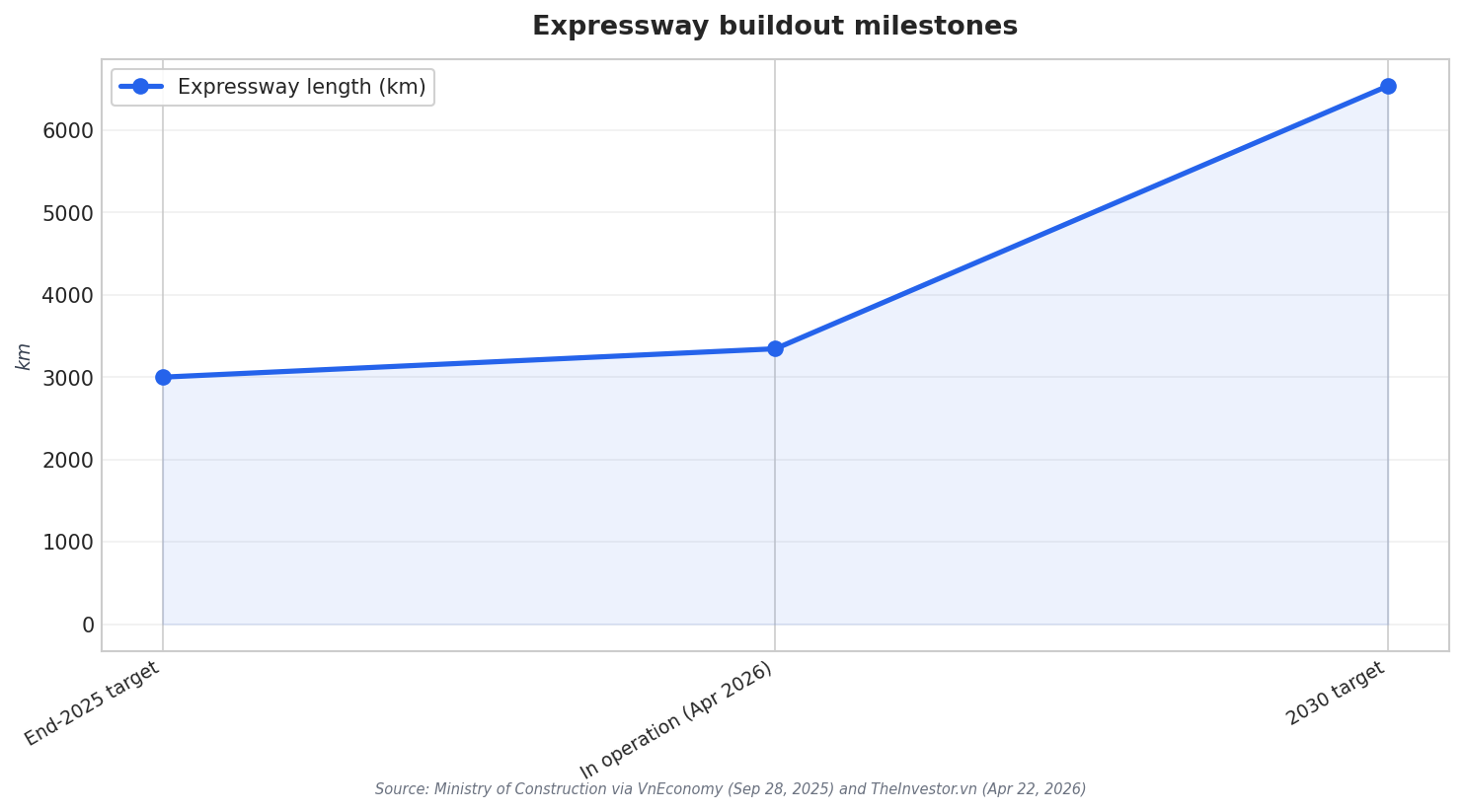
Vietnam’s push to expand expressways has moved from plan to operating reality. By April 2026, about 3,345 km of expressways were already in operation, according to Minister of Construction Tran Hong Minh. Earlier, the Ministry of Construction (MoC) described a milestone drive to reach at least 3,000 km in operation by the end of 2025, with expressway construction completed valued at VND66.532 trillion ($2.56 billion). For business, this emerging backbone matters because it changes the cost and timing assumptions that sit behind sourcing, production scheduling, and delivery promises across provinces.
The business case sits inside a wider investment cycle. Mordor Intelligence values Vietnam’s infrastructure market at USD 19.61 billion in 2025 and estimates growth from USD 20.91 billion in 2026 to USD 28.81 billion by 2031, at a CAGR of 6.62% (2026–2031). Transportation held 47.86% of the infrastructure market share in 2025, and new construction accounted for 77.45% of market size that year. Public funding captured a 72.88% share in 2025, while private investment is forecast to rise at a 9.06% CAGR between 2026 and 2031. These figures signal sustained execution work around roads, including expressways, that companies can align with.
Why Expressways Show Up in Logistics KPIs
Logistics is where the expressway impact becomes measurable. Mordor Intelligence forecasts the Vietnam freight and logistics market to grow from USD 52.06 billion in 2025 to USD 55.5 billion in 2026 and reach USD 76.39 billion by 2031, at a 6.6% CAGR (2026–2031). Road freight hauled 77.68% of revenue share in 2025, underscoring why expressways matter for most shippers. B-Company reports logistics costs still account for around 16.5%–16.8% of GDP, above the global average of 11.6%. In this context, any transit-time reduction can compound into inventory, route planning, and service-level gains rather than being a marginal improvement.
Some evidence is already being tracked in time and capacity indicators. A Vietnam Courier, Express, and Parcel (CEP) market report notes that USD 13.1 billion in airport, seaport, and expressway projects is shrinking average interprovincial transit times by up to 18%. That same report says the new Long Thanh International Airport cargo facilities promise 1.2 million tons of annual throughput, easing pressure on Tan Son Nhat and Noi Bai. For manufacturers and retailers, this mix of faster road links and added cargo capacity supports more reliable replenishment cycles and more flexible distribution footprints—especially as courier, express, and parcel services are projected to expand at a 7.52% CAGR (2026–2031).
Looking ahead, policy targets give companies a planning horizon. Vietnam aims to complete 6,539 kilometers of expressways by 2030, nearly doubling the network from the roughly 3,345 km already in operation, according to the Minister of Construction. Businesses building 2026 strategies around the Vietnam expressway network 2026 topic should also watch execution risks noted by Mordor Intelligence, including contractor fragmentation, sand shortages, and delayed public disbursements that can inflate budgets and extend timelines. Even so, the direction is clear: as the backbone expands, firms that redesign routes, warehouse placement, and delivery promises around the new operating map stand to capture the most value.
How long is Vietnam’s expressway system that is already operating?
What is Vietnam’s expressway target for 2030?
How does the Vietnam expressway network in 2026 connect to logistics performance?
How big is Vietnam’s freight and logistics market in 2026?
Why do expressways matter so much for shippers in Vietnam?