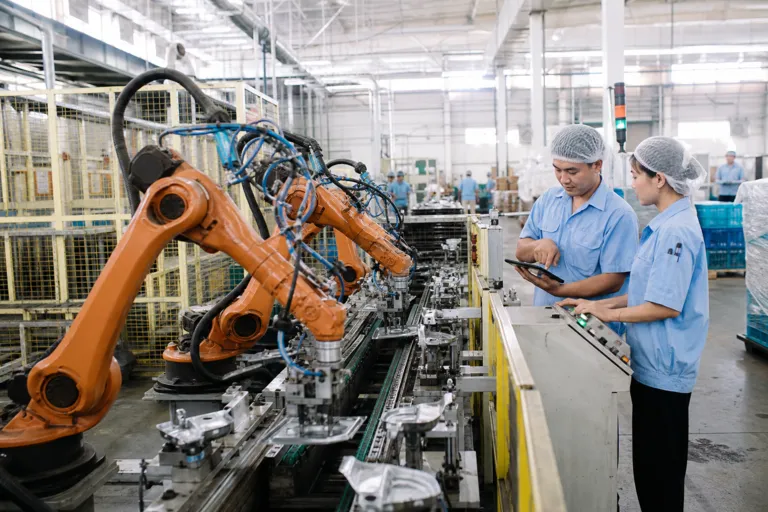
Vietnam’s automation story is no longer only about low-cost labor. Multiple market reports describe a clear acceleration in factory robotics and broader automation, tied to export manufacturing and to policy priorities under the national Industry 4.0 strategy. In 2023, Vietnam’s industrial robot market (industrial arms only) reached approximately USD 286 million, while the broader robotics ecosystem (including industrial arms, AMR/AGV, service robots, and drones) was estimated at USD 420–480 million in 2024, with a mid-point base of USD 450 million. This shift is framed as Vietnam moving from a “manufacturing adopter” toward a “regional innovator,” while still relying heavily on imported core technologies such as precision reducers, controllers, and high-end sensors.
On the factory-automation side, adoption signals are already visible at the plant level. One report states that in 2023, more than 45% of manufacturing plants in Vietnam implemented automation systems to improve operational efficiency and reduce labor dependency. It also cites over 500 newly automated facilities established in industrial zones such as Ho Chi Minh City, Binh Duong, and Da Nang over the last two years, and more than 1,200 active automation projects underway by the end of 2023. Electronics stands out in the same source, which says over 80% of electronics manufacturers incorporate some form of automation. The labor backdrop is changing too: the same source reports labor cost increased by 11.2% between 2021 and 2023, strengthening the business case for substitution and process stabilization.
FDI Clusters, Policy Signals, and Where Automation Lands First
Foreign manufacturing investment and geographic clustering shape where automation economics work best. A 2030 outlook report says processing and manufacturing absorbed USD 25.58 billion of FDI in 2024, equal to 66.9% of national FDI inflows, linking robotics payback to labor productivity, takt-time stability, and export quality compliance. It also highlights concentration in the Ho Chi Minh City industrial belt and the Hanoi high-tech corridor, noting Hoa Lac Hi-Tech Park had attracted 110 investment projects worth about USD 5 billion by 2024. Separately, the Industry 4.0 strategy is formalized through Decision 2289/QD-TTg (December 2020), which designates robotics, AI, IoT, and big data as priority technologies, and includes targets such as a digital economy at 20% of GDP and ASEAN digital leadership.
Market forecasts also point to sustained growth, but with changing mix. One forecast projects the Vietnam robotics market moving from USD 450 million in 2024 to approximately USD 758 million by 2030, implying a 9.1% CAGR during 2025–2030, after a historical CAGR of 10.4% across 2019–2024. Another source estimates the Vietnam robotics market at USD 462.65 million in 2023 and projects USD 623.49 million by 2032 at a CAGR of 3.8%. Differences in scope and methodology aside, both describe momentum beyond large export factories, with the 2030 outlook emphasizing faster growth in logistics and warehouse robots and a profit-pool shift toward recurring software, maintenance, and orchestration, rather than pure hardware resale.
The constraint story is as important as the upside for Vietnam factory robotics automation adoption. Sources repeatedly cite import dependence for core components, and a talent bottleneck that limits integration speed and uptime. One report says the manufacturing sector is projected to need 1.2 million automation/robotics workers by 2030, with supply far below demand, while also describing low SME adoption due to high upfront investment and integration complexity. Another points to weak domestic R&D capacity and notes R&D spending at approximately 0.4% of GDP. The near-term implication is straightforward: the fastest gains accrue where factories can access integrators, training, and after-sales support, and where automation is justified by export quality compliance and stable throughput.
What is driving robotics and automation uptake on Vietnam’s factory floors?
How common is automation in Vietnam manufacturing today?
How big is Vietnam’s robotics market, and what do forecasts show?
Where is Vietnam’s factory robotics and automation adoption most concentrated?
What are the biggest barriers to scaling factory robotics in Vietnam?