Vietnam’s push for more open entry is colliding with a clear ambition: turn strong demand into a record year. In January–April 2026, Vietnam recorded 8.8 million international arrivals, or around 35% of the government’s full-year target of 25 million foreign tourists. April alone exceeded 2 million arrivals, and the country recorded over 2 million foreign visitors for four consecutive months. That pace has made Vietnam’s early-2026 performance a reference point in regional coverage, with multiple reports pointing to expanded e-visa access, simplified entry requirements, and increased international flight connectivity as key accelerators.
The numbers also show how Vietnam’s inbound mix is concentrating in high-volume source markets even as new markets build. During January–April, China and South Korea together accounted for nearly 40% of total foreign arrivals. For first-quarter 2026 specifically, Vietnam welcomed about 6.76 million international visitors, described as the country’s highest first-quarter figure, and more than 12% higher than the same period of 2025. Q1 source-market detail highlights China at around 1.4 million visitors and the Republic of Korea at nearly 1.33 million. Coverage also points to triple-digit percentage gains from India, the Philippines, and Indonesia from a smaller base.
E-Visas, Gate Expansion, and Why Speed Matters
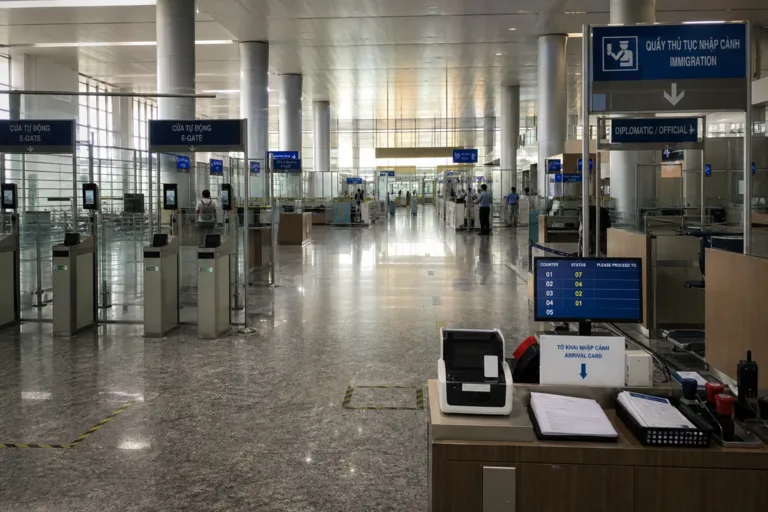
Policy changes are not just marketing slogans in Vietnam’s tourism cycle. Reports describe an expanded e-visa system, a larger list of eligible countries, and more border gates opened to electronic entry processing. MarkWide Research also frames the National Assembly’s electronic visa legislation, administered by the Immigration Department, as a friction-reducer for travelers from source markets including South Korea and Japan. At the same time, a 90-day e-visa framework is cited as giving remote workers latitude to plan multi-month stays without employer sponsorship, supporting longer-stay demand even without a dedicated digital-nomad visa category.
Behind the arrival targets sits a wider monetization and capacity story. Ken Research reports demand recovered to 21.17 million international arrivals and 135.5 million domestic trips in 2025, reinforcing a “two-engine” structure where domestic volume helps stabilize occupancy while international travelers remain disproportionately important for room rates, aviation yield, guided tours, and premium experiences. The same report notes Vietnam had about 38,000 tourist accommodation establishments and 780,000 rooms by 2023, including 247 five-star properties. It also points to Southern Vietnam as the leading commercial cluster because Ho Chi Minh City functions as the main international gateway and distribution hub for destinations including Phu Quoc and the Mekong Delta.
The “race” is therefore about value as well as volume. Ken Research projects the Vietnam Travel & Tourism Market rising from USD 40,061 Mn in 2025 to USD 70,200 Mn in 2031, a 9.8% CAGR, and flags an official 2026 objective of 25 million international arrivals, 150 million domestic trips, and approximately USD 46,500 Mn in tourism revenue. It also models average visitor spend increasing from USD 255.7 per trip in 2025 to USD 349.3 in 2031 as the mix shifts toward premium accommodation and higher-value itineraries. At the operational level, MarkWide Research warns that multilingual service training capacity can lag arrival velocity, while infrastructure gaps in northern highland provinces can constrain the experience if growth outpaces readiness.
How strong were Vietnam international tourism arrivals at the start of 2026?
What is Vietnam’s official inbound visitor target for 2026?
Which markets are leading Vietnam’s inbound growth in early 2026?
How is e-visa expansion expected to support tourism growth?
What capacity and value indicators frame Vietnam’s tourism push?