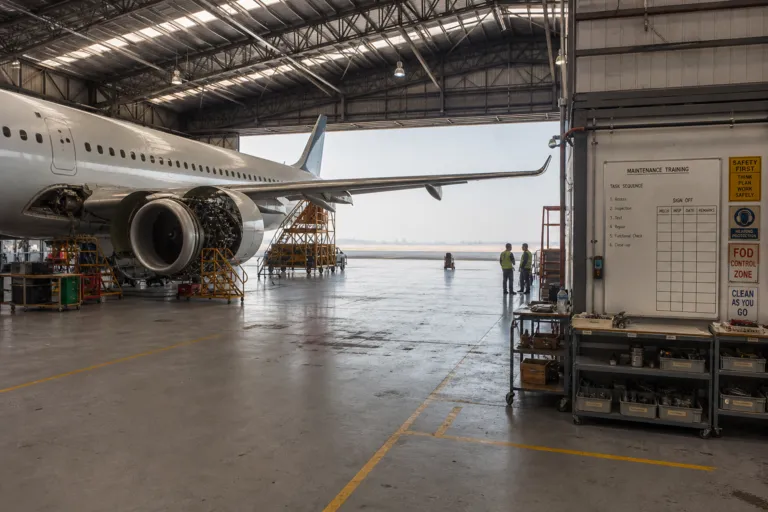
Vietnam’s airline activity is rebounding, and that brings a practical question: who keeps the aircraft flying. In the first half of 2024, Vietnamese airlines transported over 54 million passengers, a pace that pushes higher utilization and tighter turnaround needs. At the same time, fleet plans are expanding. Vietnam Airlines aims to grow to 137 aircraft by 2030 and 170 aircraft by 2035, and it concluded a deal in 2025 to purchase 50 Boeing 737-8 aircraft. Vietjet operated 94 Airbus aircraft as of 2024, while Vietnam Airlines held a 42% domestic market share and Vietjet held 43%. These numbers raise the stakes for line checks, heavy checks, tooling, and certified technicians.
That operational pressure is also tied to infrastructure. Under a CAAV proposal referenced by Vietnam Briefing, if approved, Vietnam would have 33 airports by 2030. More airports can mean more line stations and more distributed maintenance capability, but only if staffing and certification keep pace. A Market Research Future report links fleet growth to recurring pre-flight inspections, overnight checks, and periodic component swaps, and it frames Asia-Pacific as absorbing over 19,500 new aircraft deliveries through 2043 (Boeing 2024 Commercial Market Outlook, as cited). Vietnam is mentioned alongside Indonesia and the Philippines as countries expanding airport infrastructure. For local providers, this sets a runway for growth, but it also raises the bar for standardized processes and compliance.
Certification and Training: A Milestone With Real Cost Impact
A key turning point for Vietnam’s aviation maintenance ecosystem is training that meets international standards. According to Hà Nội Mới, VAECO, a subsidiary of Vietnam Airlines, was approved by the European Aviation Safety Agency as a maintenance training organization under EASA Part-147 standards. The same source says this was the first time in Vietnam an organization achieved this certification, enabling training of maintenance engineers to European standards and issuing certificates related to signing aircraft maintenance approvals. Part-147 also supports localizing training, with estimated cost savings of up to 90% compared with overseas training. Hà Nội Mới adds that VAECO became one of only four organizations in Southeast Asia to simultaneously hold EASA Part-145 and Part-147, positioning Vietnam to compete more credibly in a region with more advanced MRO nations.
Even with progress, the ecosystem challenge is clear: technology matters, but people matter most. The Vietnam Civil Aviation Authority’s Director General, Uong Viet Dung, emphasized that flight safety is the industry’s central pillar and that the “core value” of safety originates from people, with human factors prioritized in training and delegation. Regionally, the economics underline why capability-building is attractive. Mordor Intelligence data cited by Hà Nội Mới states that engine maintenance and repair alone will account for 43.24% of aircraft maintenance and repair market share in the Asia-Pacific region by 2025, and that maintenance costs can range from tens of thousands to millions of USD per engine. For the Vietnam aviation MRO market, that mix makes workforce depth, certification, and process discipline decisive for capturing higher-value work.
Demand signals are also coming from business aviation. Vietnam Investment Review cited Asian Sky Group data showing business jets based in Vietnam rose by 67% in one year, from nine to 15 aircraft. The same report notes Vietnam ranks sixth in Southeast Asia by fleet size, behind Singapore, Indonesia, the Philippines, Thailand, and Malaysia, and it highlights that larger aircraft require more complex maintenance while a small fleet can limit the feasibility of full-scale domestic capabilities. This points to a near-term hybrid model: expand local training and approvals, grow line and base maintenance capacity as fleets scale, and selectively use nearby regional MRO strength where it is more economical. With airport expansion proposals and airline fleet growth plans moving ahead, Vietnam’s maintenance sector is preparing to match ambition with execution.
What is driving MRO demand in Vietnam right now?
Why does EASA Part-147 matter for Vietnam’s maintenance workforce?
How important is engine work in the regional MRO picture?
What does business aviation growth mean for maintenance support needs?
What is changing in the Vietnam aviation MRO market, and what still holds it back?