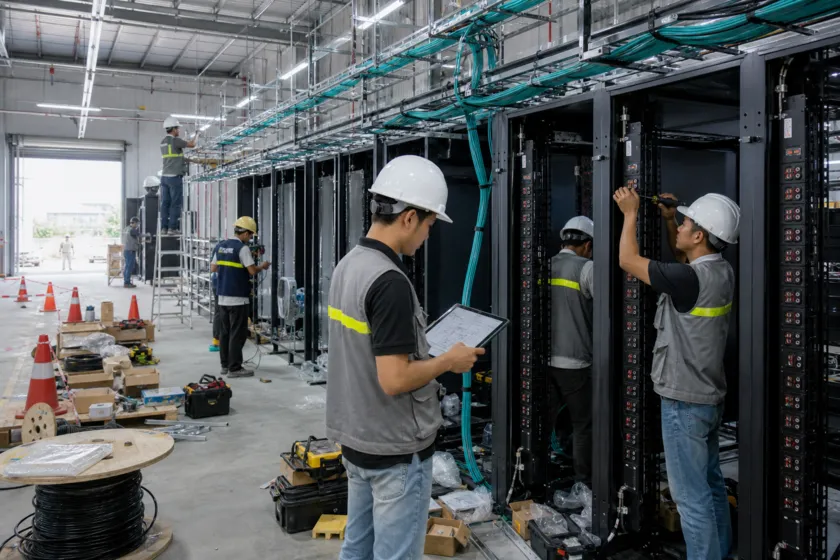
Vietnam’s AI data center momentum is becoming a defining theme in its digital buildout. A major signal is the artificial intelligence data centre project at Tan Phu Trung Industrial Park, valued at about USD 2.1 billion. The project is backed by a joint venture between Accelerated Infrastructure Capital (AIC), Kinh Bac City Development Holding Corporation, and international partners. Construction is expected to begin this month, putting a concrete timeline on new compute-heavy infrastructure. This is also arriving as Vietnam emphasizes completing strategic infrastructure, including digital infrastructure, to support large-scale production and high-tech industries.
The push is not only about pouring concrete. Vietnam is also prioritizing administrative reform that is more substantive, with the explicit goal of cutting compliance costs and shortening processing times. Those points matter because investors increasingly prioritize them. Alongside that, Vietnam highlights the development of high-quality human resources aligned with technology-driven sectors such as semiconductors, AI, and modern logistics. This combination is framed as essential for shifting from broad-based foreign direct investment attraction to deeper, value-added investment. In practice, that shift supports AI data centers that need reliable permitting, predictable execution, and a workforce that can operate complex digital systems.
Why AI Data Centers Are Pulling Capital Into Vietnam
One reason the narrative is accelerating is that Vietnam is positioning itself within a wider AI transformation. Sovico Group Chairwoman Nguyen Thi Phuong Thao described an era in which AI, semiconductors, data, and digital economies are reshaping production and daily life. She also said Vietnam currently ranks among the world’s top six countries most open to artificial intelligence. Policy is being used to reinforce that direction. Action Program 03/NQ-CP implements Resolution 57 by requiring ministries and localities to remove institutional barriers and develop special mechanisms for investing in and procuring new technologies, while Vietnam also builds innovation and startup centers tied to strategic sectors.
Talent and industrial depth are another magnet for the Vietnam AI data center investment story. Vietnam already hosts over 50 IC design companies with about 7,000 engineers, plus 15 firms specializing in chip packaging and testing with over 10,000 technicians. Major technology companies including NVIDIA, Qualcomm, Apple, Samsung, and Amkor have chosen Vietnam as a production base or R&D hub, and NVIDIA and Qualcomm selecting Vietnam for AI and semiconductor research is described as a sign of growing global stature. Vietnam has also passed the Law on Digital Technology Industry and is drafting a Law on Key Industries, while rolling out tax, land, infrastructure, and human capital incentives to attract higher-quality FDI and encourage local R&D.
Vietnam’s buildout also sits inside a regional and global investment climate that is scaling quickly. In Asia, a data center capacity pipeline expanded by 2.75 GW to 19.37 GW, with 3.68 GW already under construction and the rest still being planned. Globally, Brookfield’s research forecasts a USD 7 trillion AI infrastructure spend for 2025–2034, including USD 2 trillion directed to AI data centers. Brookfield also anticipates AI-oriented data centers will reach roughly 15 GW of capacity by the end of 2025, up from about 7 GW at the end of 2024, with total capacity projected to reach around 82 GW by 2034. Against this backdrop, Vietnam’s AI data center boom is being shaped by both local execution, such as the USD 2.1 billion Tan Phu Trung project, and the scale of capital now chasing AI-ready digital infrastructure.
What is the largest AI data center project cited in Vietnam, and how much is it worth?
What reforms is Vietnam emphasizing to support large-scale digital infrastructure projects?
Why does Vietnam’s openness to AI matter for the data center boom?
How do global AI infrastructure forecasts help frame Vietnam’s AI data center investment wave?