

Vietnam’s move toward ending bank-by-bank credit ceilings is becoming one of the clearest signals of a monetary policy shift. The State Bank of Vietnam (SBV) has used credit growth quotas since 2011, a period linked to hyperinflation and excessive money supply. But by 2026, the SBV plans to test removing credit limits, which S&P Global Ratings describes as a change from administrative control to market-based discipline. Separately, Vietnam Law & Legal Forum reports that removing quotas is intended to replace an administrative tool with a market mechanism and improve transparency and the “health” of the credit system.
In practice, the quota framework still shapes how banks behave and how the SBV tries to smooth credit cycles. Vietnam Investment Review reports the SBV has set an overall credit growth target of approximately 15% for 2026, treating it as more than a number and using it to manage capital flows over time. The same source highlights why quarterly management matters: when banks front-load lending, policy flexibility later in the year shrinks, and the system can take on more risk. In 2025, some banks recorded first-quarter credit growth of over 5–6%, and this early surge contributed to the year’s policy-management difficulties.
What This Shift Signals for Bank Strategy and Risk Controls
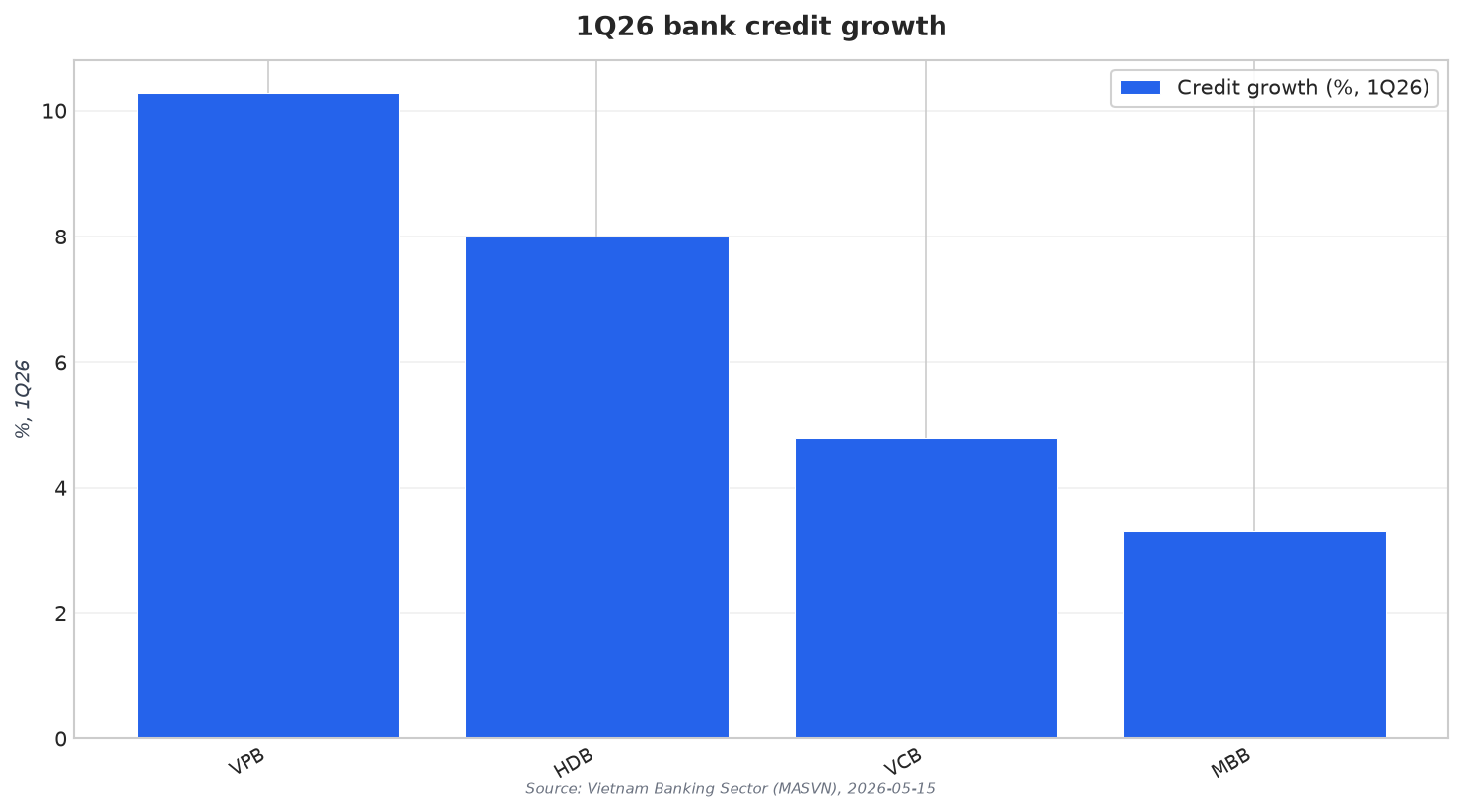
Early 2026 data also hints at how banks may adapt as quotas are allocated more gradually rather than all at once. A Maybank Securities Vietnam sector note states listed banks posted aggregate credit growth of around 3.6% in 1Q26, with dispersion narrowing versus 2025. The same note points to named bank momentum, including VPB (+10.3%), HDB (+8.0%), VCB (+4.8%), and MBB (+3.3%). It also observes that as quotas are granted more gradually through the year, banks have less urgency to compete aggressively at the start, reinforcing the SBV’s stated goal of more balanced quarterly distribution.
For lenders, the bigger signal is that quota removal is not a simple “off switch.” Vietnam Investment Review notes repeated calls from the Prime Minister to remove administrative quotas, but also stresses removal requires robust risk monitoring, stronger governance standards, and effective post-control mechanisms. The SBV’s current stance is framed as pragmatic: keep quotas as a macroprudential valve while improving transparency and discipline in allocation. This matters because risk-management capacity is uneven across banks, and administrative tools are still viewed as necessary to prevent sentiment-driven credit booms or short-term stimulus cycles.
The vietnam credit growth target reform also sits alongside tightening capital expectations and a wider financing challenge for the economy. Vietnam News reports that S&P links quota removal plans with the introduction of Basel III capital rules, warning the shift could widen the gap between stronger and weaker lenders. In parallel, VietnamNet argues monetary policy keeps carrying Vietnam’s growth financing burden because the corporate bond market is recovering slowly and the stock market is not yet a sufficiently strong fundraising channel. It contrasts regional credit-to-GDP ranges: Indonesia and the Philippines at about 40–60%, and Thailand and Malaysia around 120–130%, with Malaysia supported by a more developed capital market. The direction of travel suggests quota reform will be judged not only by bank growth, but also by whether alternative funding channels deepen enough to share the load.
When does Vietnam plan to test removing credit growth quotas?
What credit growth target has the SBV set for 2026?
What does early-2026 credit growth show about bank behavior under gradual quota allocation?
Why is removing quotas described as complex, not just a deregulation move?
How does the Vietnam credit growth target reform relate to bank capital rules?