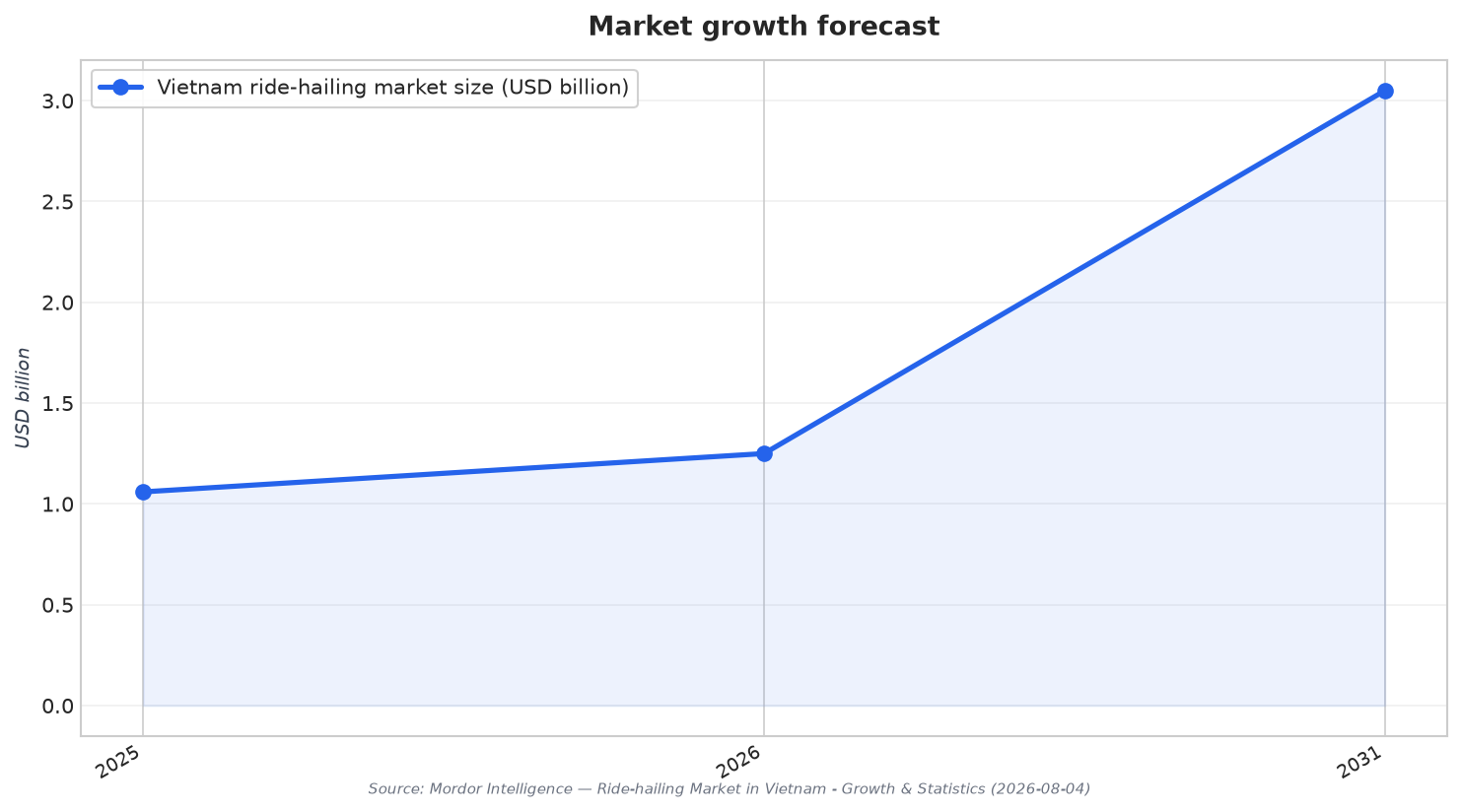
Vietnam’s ride-hailing arena is expanding fast, but the competitive logic is changing. Mordor Intelligence valued the market at USD 1.06 billion in 2025 and estimated growth from USD 1.25 billion in 2026 to USD 3.05 billion by 2031, at a 19.53% CAGR for 2026–2031. Verified Market Research also framed a rapid growth trajectory, valuing the market at USD 2.14 billion in 2024 and projecting USD 8.61 billion by 2032 with a 19% CAGR over 2026–2032. Behind the forecasts, the market’s center of gravity is pulling toward apps, e-wallet promotions, and platform ecosystems that can subsidize rides through other verticals.
Usage patterns and segment shares show why scale matters. Mordor reported that in 2025, two-wheelers led with 61.36% share, while app-based bookings accounted for 88.82% of revenue share and e-hailing represented 83.35% of revenue share. The personal segment made up 77.37% of 2025 revenue, even as corporate accounts were expected to grow at a 19.59% CAGR as firms shift from owned fleets to subscription packages. A separate snapshot of adoption from B-Company put Vietnam’s ride-hailing user base at about 28.1 million in 2024, projecting 37 million users by 2029 and citing that 77% of users ride at least three times a month. In Hanoi and Ho Chi Minh City, average monthly spend was reported at VND 252,000 (USD 9.7) on car-hailing and VND 105,000 (USD 4) on motorbike rides.
Green Fleets vs. Super Apps: Two Strategies Collide
The “green fleet” strategy centers on electrification and tighter control of service quality through owned or closely managed vehicles. Mordor noted that internal-combustion vehicles still controlled 73.27% of 2025 market size, while battery-electric fleets are expanding at a 19.65% CAGR through 2031. Policy is part of the calculus: Mordor pointed to Decree 51/2025 eliminating EV registration fees for a significant period and lowering special consumption tax for EVs compared with ICE cars. B-Company also cited Decision No. 876/QĐ-TTg, describing targets where from 2025 all newly invested or replacement buses must use electric or green energy, and by 2030 at least 50% of all vehicles and 100% of new taxis must be electric or green-powered.
Super apps, however, fight with breadth and cross-subsidy. Mordor highlighted that super apps can subsidize fares using food-delivery and fintech profits, strengthening loyalty. Survey and share signals reinforce that advantage. The Vietmedia cited a Rakuten Insight survey where 55% of Vietnamese users rely on Grab most often, compared with 32% for Xanh SM and 24% for Be, attributing Grab’s edge to an ecosystem spanning ride-hailing, food delivery, and payments. In food delivery, the same source reported GrabFood at 50.6% share and ShopeeFood at 41.7%, while noting Xanh SM’s entry into delivery in May 2025 with “Xanh SM Ngon.” Expansion tactics also matter: in 2025, Grab added nine northern provinces to reach 50 provinces and cities, and promoted GrabBike first rides at VND 6,000 (about USD 0.24) in new markets.
Regulation and profitability pressures are tightening the battlefield. Mordor said Decree 158/2024 allows local transport departments to cap vehicle numbers, which can raise entry barriers and benefit incumbents with provincial-level operating licenses. Competitive positioning is also evolving: AgileTech argued Vietnam’s likely near-term shape is “tiered coexistence,” with four-wheel ride-hailing tilting toward consistency and owned or franchised EV fleets, while two-wheel ride-hailing tilts toward dense marketplaces. Meanwhile, Be is trying to prove a durable economics-led route; The Vietmedia reported Be announced it turned EBITDA-positive for the first time in November 2025, and that 24% of its users choose Be for cheaper fares while 23% cite promotional deals. For the vietnam ride hailing market, the next phase may be decided less by a single winner and more by which model best fits each segment.
How fast is Vietnam’s ride-hailing market projected to grow?
What share of rides is driven by apps and e-hailing in Vietnam?
What do the numbers say about motorcycles versus cars in Vietnam ride-hailing?
Who do Vietnamese users rely on most often, according to survey data?
What is changing competition in the Vietnam ride hailing market right now?