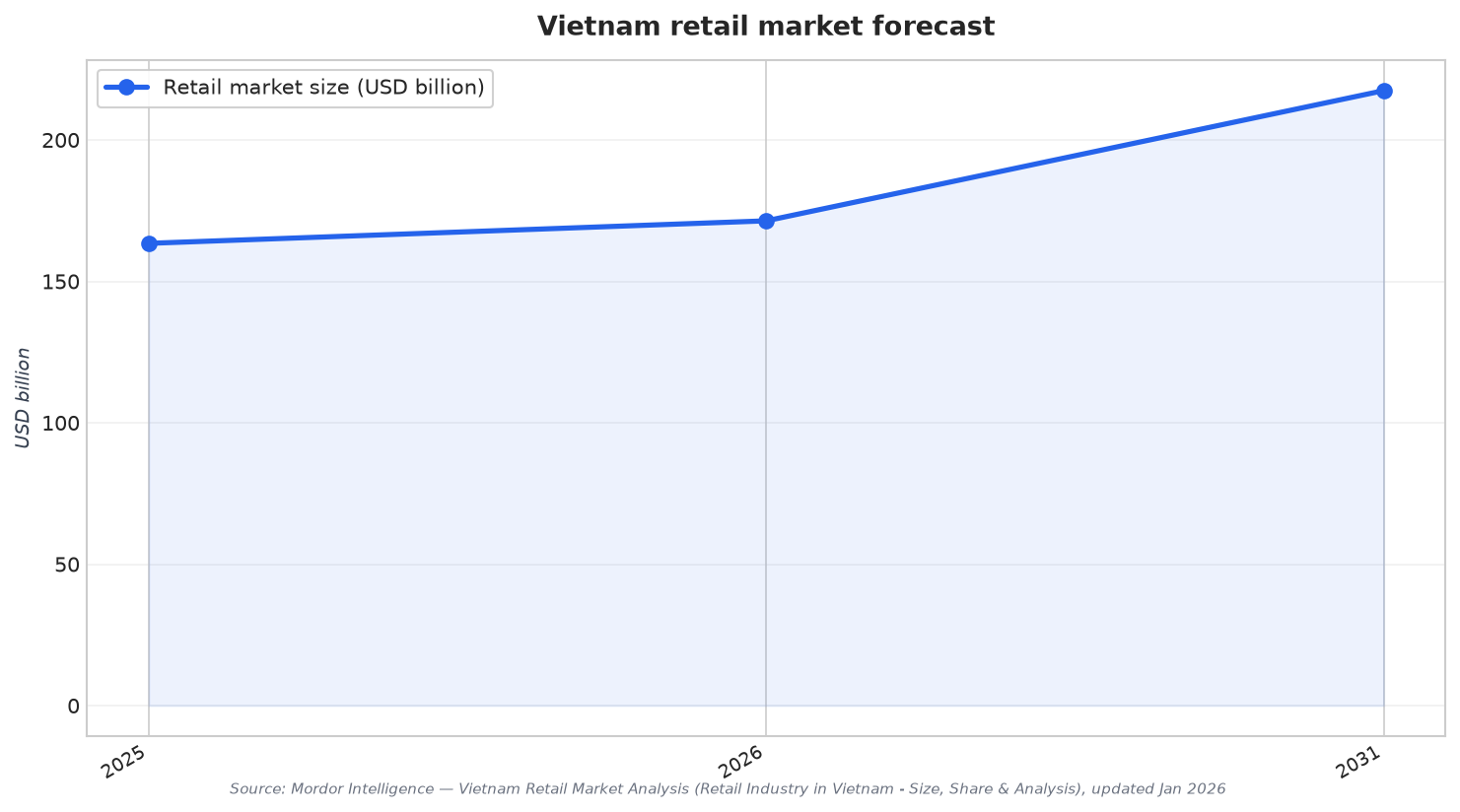
Vietnam’s retail landscape is being pulled in two directions at once: consolidation after the post-pandemic rebound, and a fast shift toward formats built for quick trips and dense urban living. Mordor Intelligence projects the Vietnam retail market will expand from USD 163.44 billion in 2025 and USD 171.40 billion in 2026 to USD 217.44 billion by 2031, a 4.87% CAGR for 2026–2031. The same analysis describes growth moving from volume to value, with chains prioritising margin defense and supply chain upgrades as urban cores approach saturation. In that environment, convenience footprints fit the mission: frequent baskets, controlled execution, and store economics that can work where big boxes cannot.
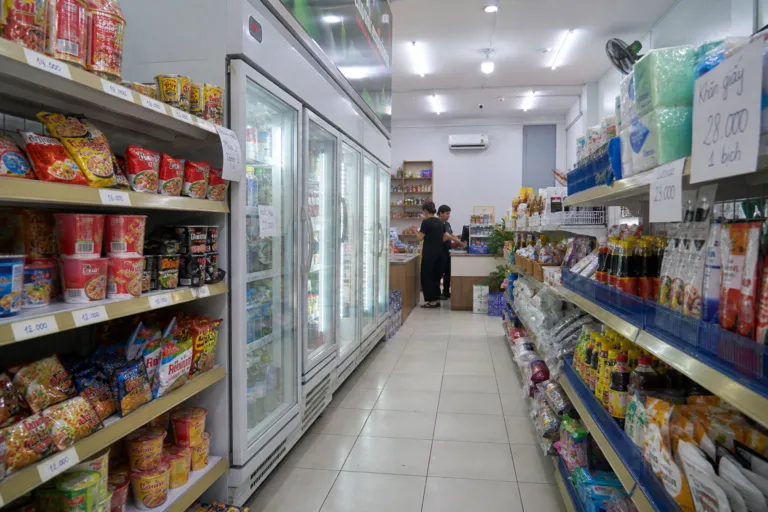
At the category and channel level, the numbers show why small formats matter. Food, Beverage & Tobacco captured 48.35% of Vietnam retail share in 2025, which makes daily essentials the core prize. Yet traditional mom-and-pop stores still held 59.35% of retail share in 2025, highlighting how much demand remains outside chain networks. Convenience stores already commanded a 32.32% share by format in 2025 and are forecast to grow at a 6.35% CAGR through 2031, according to Mordor Intelligence. This is also happening as e-commerce and hybrid models are projected at a 5.75% CAGR for 2026–2031, reinforcing the pressure for omnichannel-ready, fast-replenishment store networks.
Why Chains Are Racing to Build Proximity Networks
Reported store counts and opening plans explain the intensity of the minimart race. VietnamPlus, citing VNDIRECT Securities Corporation, says there are about 7,483 convenience stores and minimarts nationwide, accounting for more than 93% of all modern retail outlets. That “bring supermarkets closer to home” model is now being scaled by the largest operators. Bach Hoa Xanh (BHX), owned by Mobile World Investment Corporation (MWG), plans to open around 1,000 new stores in 2026, focusing on northern regions, with Ninh Binh province piloting 20 stores. WinMart+ under WinCommerce also plans to open 1,000 new stores in 2026, including more than 300 launched in the first quarter, with expansion focused on the North and Central regions.
Foreign chains are expanding too, and competition is visible in Hanoi. VietnamPlus reports GS25 plans to continue expanding in northern Vietnam and had opened its 50th store in Hanoi by the end of last year, while already operating more than 400 stores in the South. In Hanoi, 7-Eleven and GS25 are competing with Circle K, which VietnamPlus says has more than 190 stores and has long dominated the market there. Operators are also working to prove that growth is not only from new openings. A separate Vietnam.vn report says that in the first six months of 2026, WinMart and WinMart+/WiN systems achieved revenue of nearly VND 23,000 billion, up 28% year-on-year, with approximately 1.6 million shoppers per day, up 24%.
Policy and operating-model changes are reinforcing the direction of travel. VietnamPlus cites a 2025 report under the Ministry of Industry and Trade that the retail market for goods and services reached 269 billion USD, with pure retail accounting for more than 70%, and growth remaining stable at around 8–9% annually. Experts forecast modern retail channels could reach about 40% of total retail sales by 2030, equivalent to nearly 180 billion USD. On execution, Vietnam.vn describes chains investing in supply chain, data, and technology, including AI for demand forecasting and inventory management. Another Vietnam.vn piece says point-of-sale scoring models and centralized ordering helped save about 15% of operating costs, equivalent to nearly 300 billion VND, supporting a push to scale beyond major cities.
How fast is Vietnam’s retail market projected to grow through 2031?
How many convenience stores and minimarts are reported nationwide, and why does that matter?
Which chains have announced major store opening plans for 2026?
What does the keyword topic—Vietnam modern retail convenience stores—look like in Hanoi competition?
What performance signals suggest modern chains are gaining traction beyond new openings?