Vietnam’s push to convert municipal trash into electricity is accelerating in its biggest cities, where waste volumes and landfill pressure are the most visible. A Vietnam-focused market assessment values the country’s waste-energy market at USD 50 million and points to Ho Chi Minh City and Hanoi as leading centers because they have high waste volumes, evolving collection systems, and stronger infrastructure. A separate investor-oriented brief cites Ministry of Natural Resources and Environment context that urban areas contribute over 60% of municipal solid waste volume, and that in large cities such as Hanoi, Ho Chi Minh City, Hai Phong, or Da Nang, per-person waste generated per day is over 0.8 kg. These dynamics explain why city governments are central to the rollout, not just national planners.
Policy framing is also becoming clearer. The same Vietnam market report says that in 2024 the government announced a strategic plan to enhance waste-to-energy capacity and integrate more projects into the national energy framework, linking the initiative to Power Development Plan VIII and urging local governments to align with national energy and environmental strategies. The investor brief adds a concrete local target: Ho Chi Minh City aims for at least 80% of urban waste to be treated by recycling or waste-to-energy technologies by 2025. It also notes that electricity produced from waste is recognized within Vietnam’s renewable and clean-energy portfolio, alongside efforts to establish tariff mechanisms and investment frameworks intended to make projects more financially attractive. Together, these signals help explain why project pipelines are increasingly discussed as city-by-city infrastructure programs.
Who Builds and Operates the Projects—and Why It Matters
Vietnam’s buildout is also shaped by who develops and operates plants. FULCRUM reports that Vietnam hosts the largest number of these projects in Southeast Asia, and describes long-term Build-Operate-Transfer (BOT) concessions as a model that can shift critical waste handling and energy generation functions toward private firms, especially where waste collection systems are fragmented and technical capacity is limited. It cites the Can Tho Waste-to-Energy Plant as a Vietnam example developed by China Everbright Environment. The same Vietnam market report lists a wide set of named players and project-linked entities active in the country’s waste-energy landscape, including Hau Giang Biomass Power, Vietstar, T&J Green Energy, Thuan Thanh Environment JSC, Hitachi Zosen, Watrec, Becamex IDC, Tam Sinh Nghia, Vietnam Waste Solutions, and C&G Environmental Protection. This mix of domestic and international participation reinforces the idea that execution capacity and operations discipline are as important as construction.
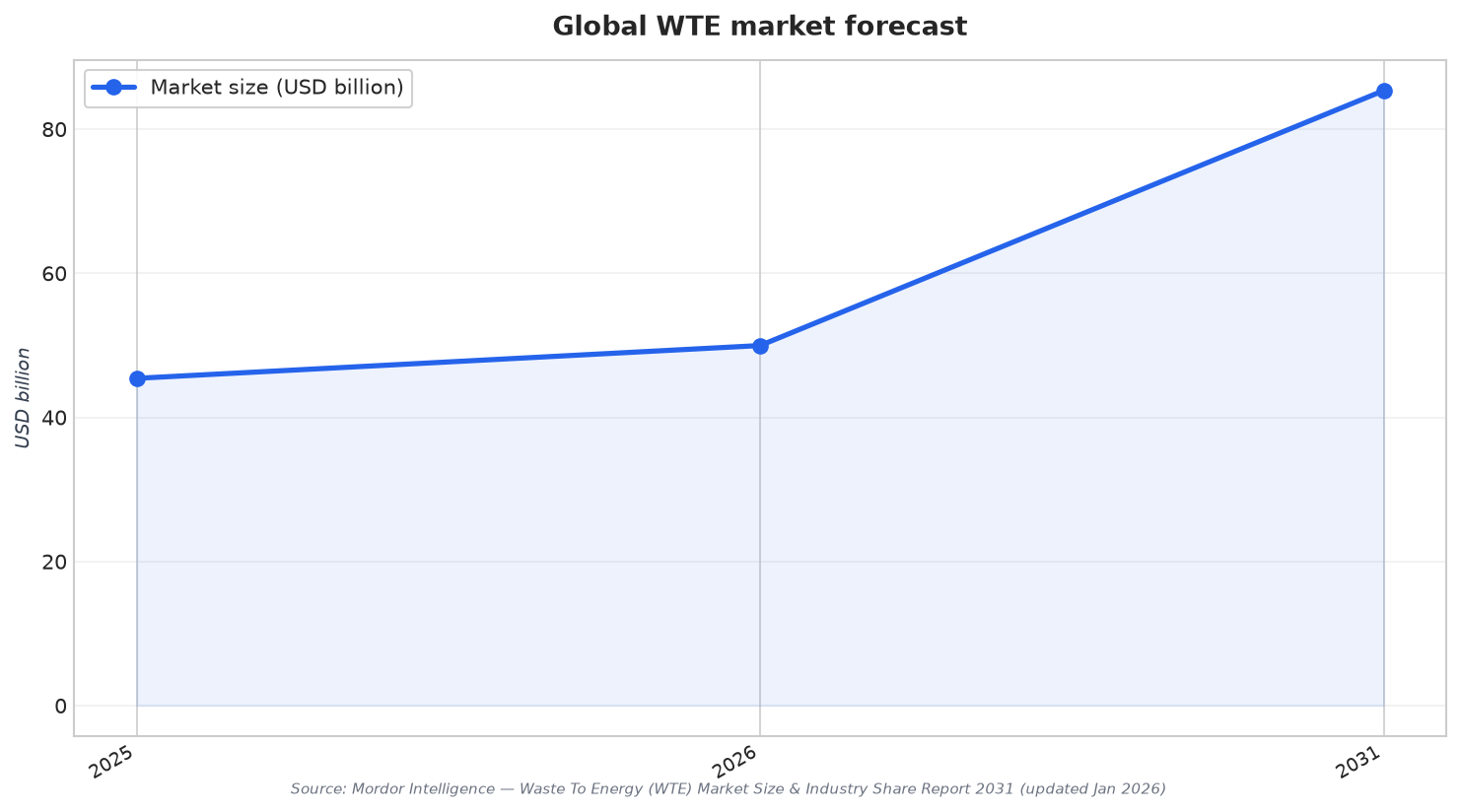
Regional and global market conditions add context for financing and technology choices, without being Vietnam-specific performance guarantees. Mordor Intelligence projects the Southeast Asia waste-to-energy market to reach USD 4.22 billion in 2025 and grow at a 12.79% CAGR to USD 7.70 billion by 2030, highlighting major operators such as Mitsubishi Heavy Industries Ltd, Keppel Corporation, PT Yokogawa Indonesia, Veolia Environment SA, and Hitachi Zosen Corp. On the global side, Mordor Intelligence forecasts the waste-to-energy market to grow from USD 45.42 billion in 2025 to USD 49.97 billion in 2026 and reach USD 85.35 billion by 2031, with incineration and combustion holding 65.1% share in 2025 and municipal solid waste accounting for 70.2% of feedstock. This backdrop helps explain why Vietnam waste to energy plants are being developed with an eye on proven municipal solid waste pathways, while investors track bankability, offtake structures, and operational accountability.
For major Vietnamese cities, the practical question is how fast these systems can scale while maintaining reliable operations and governance. FULCRUM emphasizes that these projects can involve multi-decade operational commitments, which embeds operators into day-to-day municipal infrastructure. That governance dimension matters because urban waste is already a dominant share of the national load, and city targets like Ho Chi Minh City’s 2025 treatment goal can become the yardstick for performance. Vietnam’s stated intent to integrate more waste-to-energy into the national energy framework, paired with recognition of waste-derived electricity within clean-energy portfolios, indicates a pathway where local waste management and national power planning intersect. The result is a buildout story defined by city needs, policy alignment, and long-term operations as much as by plant construction alone.
What is driving waste-to-energy adoption in Vietnam’s major cities?
What target has Ho Chi Minh City set for waste treatment by 2025?
How is Vietnam linking waste-to-energy to national energy planning?
Who is involved in developing Vietnam’s waste-to-energy projects?
What role do long-term BOT models play in Vietnam waste-to-energy plants?