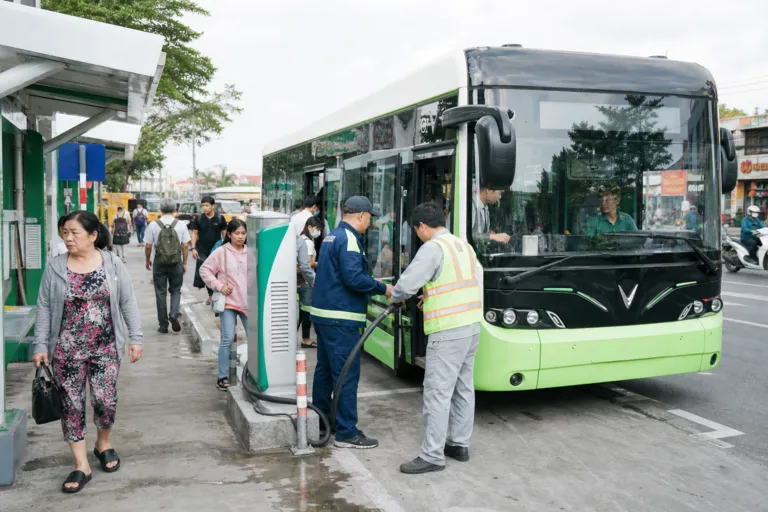
Ho Chi Minh City’s electric bus push moved from “pilot feel” to system-level change in 2026. From March 1, 2026, the city deployed 169 electric buses on nine urban routes, and 48.4% of the city’s total bus fleet was already on clean energy, according to a Vietnam EV market report. The same source frames the network as the most advanced city-scale electric transit system in mainland Southeast Asia and notes a target of 100% clean public transport by 2030. In parallel, industry commentary describes Vietnam’s electrification phase as increasingly practical in large cities, especially Hanoi and Ho Chi Minh City, where electric buses are being positioned as a response to pollution, noise, and poor commuter experience tied to older diesel fleets.
The rollout’s “model” claim hinges on more than vehicle counts. One market analysis argues that adoption often depends on user perception as much as infrastructure, and presents electric buses as quieter and cleaner at the tailpipe, while feeling more comfortable than many conventional buses still operating. It also highlights a planning shift: operators are learning to schedule routes around battery cycles, while depot charging facilities are rolled out alongside fleet additions, rather than arriving late. At the same time, the same source cautions that charging readiness is uneven, with core urban corridors getting the most attention while outer districts and secondary cities remain underprepared—suggesting that replicating Ho Chi Minh City’s progress may happen in clusters, not evenly nationwide.
What Makes This Rollout Replicable (and What Doesn’t)
Vietnam’s ability to scale electric buses is also linked to supply and operations. A key dynamic cited in industry research is local manufacturing capability, which can speed deployment and simplify maintenance and parts availability compared with markets dependent on overseas suppliers. Separate reporting on VinFast’s ecosystem adds operational detail: around 2,000 VinFast electric buses are operating in Vietnam, including roughly 600 vehicles run directly by VinBus, which completed roughly 73 million km by the end of 2025. VinBus was established in 2019 through an investment of 1,000 billion VND (over 32 million euros) and operates in five Vietnamese cities, including Ho Chi Minh City, which matters for replication because operating practices and service models can travel between cities.
Infrastructure specifics show both what’s possible and what must be planned. At one VinBus depot in Hanoi, the Ocean Park site covers approximately 10,000 square meters, can host up to 100 electric buses simultaneously, and includes 40 charging units capable of charging up to 80 buses at the same time, alongside solar panels and maintenance facilities. The same reporting says maintenance procedures are scheduled every 5,000 km. Vehicle capability details were also shared: buses average around 260 km of mileage on one charge with a 281 kWh CATL battery. These figures come from Hanoi operations, not Ho Chi Minh City, but they illustrate the operational “back office” needed if a city wants reliable headways and predictable charging.
So is Ho Chi Minh City’s rollout a real model for broader Vietnam electrification? The answer is “yes, with conditions.” Market reports describe Hanoi and Ho Chi Minh City as dominant adoption centers, supported by government-backed initiatives and incentives, and note that public transport is the largest application segment for electric buses. Meanwhile, national EV market research reports Southern Vietnam held approximately 45.21% of Vietnam’s EV market revenue in 2025, anchored by Ho Chi Minh City. But multiple sources also emphasize gaps outside major cities, with charging density and readiness lagging beyond core urban areas. That makes Ho Chi Minh City a strong reference case for city-scale planning, but not a guarantee of uniform nationwide outcomes.
How many electric buses did Ho Chi Minh City deploy in 2026, and on how many routes?
How much of Ho Chi Minh City’s bus fleet is already on clean energy?
What does VinBus’s operating scale say about Vietnam’s electric bus momentum?
What are key operational metrics from Hanoi that matter for scaling city bus electrification?
What does the Vietnam electric bus fleet expansion depend on beyond buying vehicles?