Vietnam’s rail build-out moved from broad ambition to defined procurement after Siemens Mobility signed a turnkey contract with VinSpeed High-Speed Rail Investment and Development Joint Stock Company, a member of Vingroup. Siemens’ own announcement links the deal to the Hanoi–Quang Ninh and Ben Thanh–Can Gio high-speed rail lines, and frames it as a milestone in VinSpeed’s effort to develop high-speed rail capabilities while building modern, international-standard transport infrastructure. For the industrial supply chain, the signal is practical: the agreement ties together rolling stock and multiple railway subsystems, creating one combined demand stream that can support localization planning rather than one-off imports.
The contract value is reported as €1bn by Railway Gazette International and IndexBox, with Siemens supplying 10 Velaro Novo trainsets alongside ETCS Level 2 signalling with ATO, telecommunications, and electrification equipment for two high-speed lines. IndexBox adds technical and capacity detail: each seven-car trainset is 200 m long, designed for a maximum speed of 350 km/h, and configured for 760 seats. Siemens also states the Velaro Novo uses 30% less energy than earlier models and delivers over 10% more passenger capacity. Those specifications matter for suppliers because they define repeatable requirements for interiors, systems integration, and lifecycle service capabilities tied to the same platform.
Why Localization Becomes the Real Opportunity After the First Trains
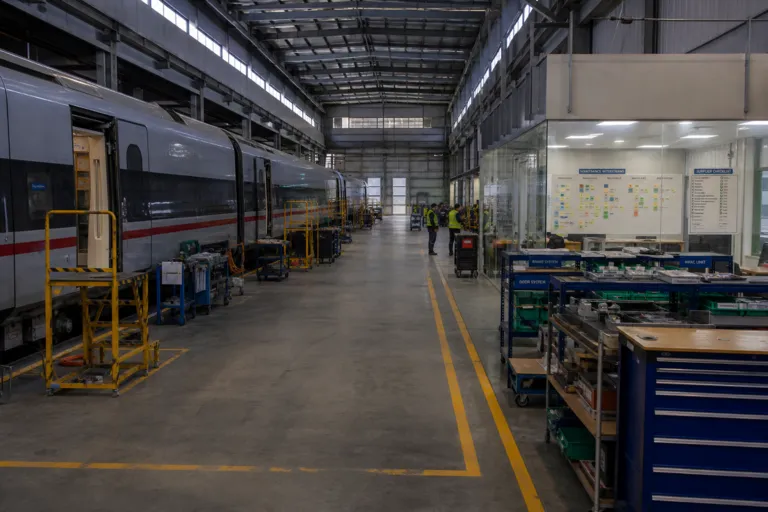
Beyond initial delivery, the most durable opportunity sits in transfer and upkeep. A Reddit post summarizing the cooperation agreement says Siemens Mobility will actively pursue collaboration in maintenance for Siemens-supplied rolling stock and subsystems, alongside technology transfer, aiming for the “highest feasible level of localization” for VinSpeed’s projects. Grand View Research similarly describes the December 2025 cooperation and technology transfer agreement as focused on enabling technology transfer and localization tied to modern rail infrastructure in Vietnam. Meanwhile, a Global Market Insights rolling stock report argues that converting these kinds of opportunities requires regional industrial footprints and financing partnerships, not simply a broad catalog, and it highlights that the strongest addressable opportunities arise when a vehicle order is coupled with signalling, depot, maintenance, and localization requirements.
The two high-speed corridors in the Siemens package also shape where local capacity can cluster. IndexBox describes one standard gauge line heading east from Hanoi to Hạ Long in Quảng Ninh province, with four stations including one at the future Gia Binh Airport. It also describes a second 54 km route running south from Ben Thanh in Ho Chi Minh City to Cần Giờ, featuring two stations and four additional ones planned later. Siemens states the collaboration establishes a foundation for future contracts, which matters because suppliers often invest in people and facilities when there is visible continuity. In parallel, Railway Gazette notes Vietnam National Railway Group took delivery of its first batch of new-generation CRRC Ziyang D19E diesel locomotives at the end of August, underscoring that multiple vendors and fleet types can coexist—raising the value of local MRO and systems expertise that can scale across programs.
For the broader discussion around Vietnam high speed rail rolling stock, the key takeaway is that the “train order” is only one layer. Siemens’ turnkey scope bundles trains with ETCS Level 2 and ATO, telecommunications, and electrification, and IndexBox reports Siemens says this is the first time ATO over ETCS will be deployed on a national high-speed line globally. That kind of integration pushes demand toward local skills in testing, commissioning, software-supported operations, and maintenance processes, not just assembly. Global Market Insights also points to how passenger-led urban projects can create serial demand for metro cars and automated-operation interfaces, citing Vietnam’s planned Hanoi metro build-out as an example of a greenfield city system that can drive repeat purchases and lifecycle support. Taken together, the post-deal opportunity is to build localized capability across vehicles, subsystems, and services that remain needed long after the first 10 trainsets enter service.
What did Siemens Mobility agree to supply for VinSpeed’s high-speed rail lines in Vietnam?
What are the reported specs of the Velaro Novo trainsets for Vietnam?
How does the Siemens-VinSpeed deal connect to localization and maintenance?
Where do the two high-speed routes described in the deal run?
What should buyers and suppliers watch in Vietnam high speed rail rolling stock projects after the first train delivery?