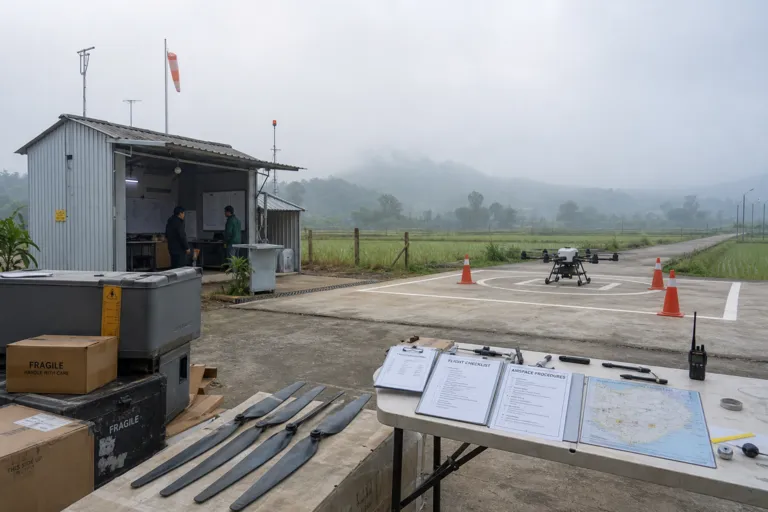
Business activity below about 1,000 meters is being reframed as a new “traffic layer” above roads, built around UAVs, small aircraft, and the control, communication, data, and management systems that keep flights organized. This is the core idea behind the Vietnam low altitude economy, where drones are no longer treated as a stand-alone gadget for filming. Instead, each flight can anchor a service stack that includes manufacturing, batteries, sensors, cameras, control software, digital maps, maintenance, UAV pilot training, insurance, telecommunications, and air traffic control and management centers. In Vietnam, initial assessments suggest the broader ecosystem could reach about USD 10 billion and create around one million jobs by 2035 if market development, technology progress, and legal frameworks advance together.
Several concrete operations show why drone logistics is becoming more than a lab demo. A postal delivery route using UAVs is scheduled to be deployed in February 2026 between Can Gio and Vung Tau. The route is more than 12 km and is expected to be covered by an autonomous aircraft in about 15 minutes. A controlled pilot program in Dien Bien is aiming for approximately 6,000 UAV flights, focusing on real needs such as agriculture and goods transport rather than pure technology showcases. In emergencies, drone operations have already provided proof of usefulness: Viettel deployed five drones during historic floods and completed 300 flights in just a few days, delivering nearly 3 tons of food and essential goods to hard-to-reach areas in Khanh Hoa province.
From Hardware Sales to a Full Ecosystem of Services
Sources distinguish between the drone market itself and the larger low-altitude ecosystem that forms around flight services. In the narrow sense, Vietnam’s drone market is projected to grow from about USD 140 million in 2025 to over USD 445 million in 2034. But the larger value pool can include logistics, data, telecommunications, infrastructure inspection, software, and operations support. Agriculture already demonstrates how quickly service demand scales when time and labor constraints are tight. In the Mekong Delta, agricultural drones can take only 3–5 minutes to spray pesticides, or up to 10 minutes to spread fertilizer and sow rice seeds per hectare, shortening production processes. One cooperative in Can Tho noted that a rice crop requires at least seven sprayings, and with three crops a year that totals 21 sprayings, making reduced chemical exposure a practical benefit for farmers.
Adoption indicators vary by source, but each points to momentum. One estimate says the Mekong Delta alone has 3,000 drones serving 1.5 million hectares, and that by 2025 Vietnam could reach 6,000 drones nationwide. Another source highlights a different snapshot: about 10,000 agricultural drones and 30,000 pilots in the Mekong Delta, alongside the observation that the region rarely experiences storms and floods, suggesting capacity could be redirected across seasons and regions. On the industry side, the market for UAVs and agricultural robots is projected to reach USD 363.7 million by 2030, with growth of 4.76% per year, large enough to support operations, maintenance, and training services as stand-alone businesses.
Regulation and infrastructure are presented as the hinge between pilots and scale. The Civil Aviation Authority of Vietnam is described as leading a regulatory push by studying international standards for low-altitude airspace management, generally defined as below 1,000 meters, with updates needed in defense and civilian aviation laws to accommodate uncrewed aerial systems and future passenger-carrying eVTOL aircraft. Officials are coordinating with the Ministry of National Defense on designated flight corridors that separate commercial drone operations from military airspace. The same roadmap highlights the need for ground investment such as vertiports, charging stations, and automated traffic management systems, while major Vietnamese technology and telecommunications enterprises are partnering with municipal authorities in Hanoi and Ho Chi Minh City to pilot smart-city logistics using heavy-lift delivery drones.
What does a low-altitude economy mean in Vietnam’s context?
What is a real example of drone delivery starting in Vietnam?
How big could the Vietnam low altitude economy become, according to initial assessments?
What numbers show drone use in flood relief operations?
What is the forecast for Vietnam’s drone market versus the wider ecosystem?