Climate resilience in ASEAN is becoming increasingly important as Southeast Asian cities face rising exposure to flooding, coastal erosion, extreme weather, and other environmental risks. Strengthening urban resilience requires investment in protective infrastructure, disaster preparedness, and planning systems that can reduce disruption to communities and economic activity.
According to the Future ASEAN Sustainable Cities whitepaper by Eurogroup Consulting, developed in cooperation with the French Foreign Trade Advisors (CCE), four of the ten major cities globally most threatened by rising sea levels are located in Southeast Asia: Jakarta, Manila, Ho Chi Minh City, and Bangkok.
For governments and businesses, climate resilience is therefore not solely an environmental concern. It is closely connected to infrastructure reliability, asset protection, business continuity, and future investment decisions.
ASEAN's Urban Climate Exposure: A Growing Infrastructure Challenge
Many of the region's major urban centers are located along coastlines, river systems, and low-lying areas where concentrated populations and economic activities can be vulnerable to flooding and extreme weather.
Rapid urbanization can intensify these risks. As cities expand, additional buildings, roads, and industrial facilities may increase pressure on drainage systems and other critical infrastructure.
The Eurogroup Consulting whitepaper highlights the scale of disaster-related disruption in the region. More than 69 million people were displaced by climate and natural disasters in Southeast Asia between 2010 and 2021, averaging approximately 5.8 million people annually over that period.
The report also cites ASEAN Secretariat data recording 1,089 flood events across ASEAN countries between 2012 and 2020, making flooding the most frequently recorded disaster category in that dataset.
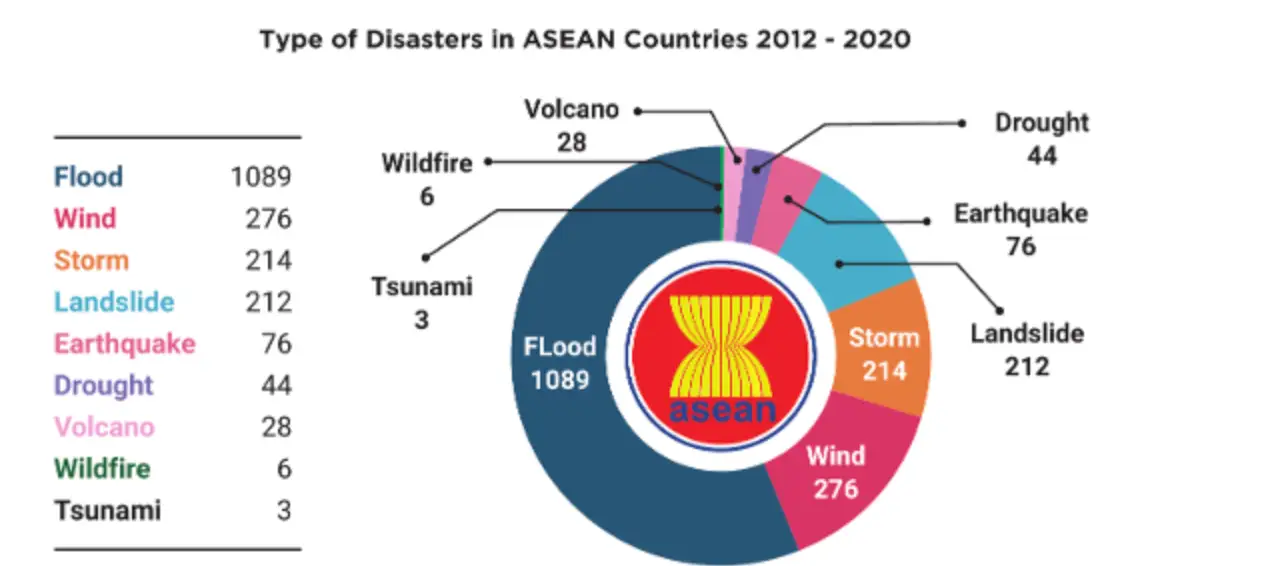
Type of Disasters in ASEAN Countries, 2012–2020. Source: Future ASEAN Sustainable Cities, Eurogroup Consulting (p. 21), based on ASEAN Secretariat.
For city planners and engineering companies, resilience therefore involves considering future hazards during the design, construction, and maintenance of buildings, utilities, transportation systems, and other essential facilities.
What Could Climate Change Cost Southeast Asian Economies?
Flooding and severe weather can interrupt industrial production, disrupt logistics networks, damage commercial assets, and reduce access to public services. These effects can influence investment confidence and the long-term attractiveness of urban markets.
The Eurogroup Consulting whitepaper presents estimates suggesting that Southeast Asia's GDP could decline by between 4.2% and 37.4% by 2050, depending on the level of global warming. The lower estimate is associated with a scenario involving warming below 2°C, while the upper estimate reflects a 3.2°C warming scenario. These are scenario-based estimates rather than predictions of a single inevitable economic outcome.
For business leaders, manufacturing facilities, warehouses, commercial property, and transport connections can be exposed to physical hazards that affect operational continuity. Projects may require additional protective measures, stronger construction standards, improved drainage, or more sophisticated monitoring systems. Although these measures can increase initial development costs, they may also reduce the potential for future disruption and asset damage.
Different Cities, Different Risks: Why Resilience Strategies Must Be Local
ASEAN countries face different environmental challenges and have varying levels of institutional and financial capacity to address them.
Singapore is highlighted in the whitepaper for its coordinated and long-term approach to coastal protection. The report describes plans to invest more than US$70 billion over approximately a century in measures including coastal defenses, polders, and land-elevation projects.
Vietnam provides a particularly relevant example. The Mekong Delta faces challenges linked to flooding, saltwater intrusion, changing rainfall patterns, and coastal pressures. The whitepaper identifies mangrove restoration, sea-dike improvements, and community-focused disaster management among the approaches being pursued in Vietnam.
The country's Mekong Delta Integrated Climate Resilience and Sustainable Livelihoods Project also illustrates how resilience planning can combine water-resource management, infrastructure improvements, and adaptation measures.
Investment in water and sanitation infrastructure forms part of this wider challenge. Explore the financing and infrastructure pressures affecting the country's water sector in The Coming Water Crunch: Vietnam's Race to Fund Water and Wastewater Infrastructure.
From Disaster Response to Resilient Urban Design
Climate resilience requires cities to move beyond emergency response toward preventive planning. Protective infrastructure, real-time monitoring, risk mapping, and water-sensitive urban design can help reduce vulnerability before disasters occur.
One example is Bangkok's Chulalongkorn University Centenary Park, designed to improve stormwater management in a densely developed urban environment. According to the report, the park incorporates water-retention infrastructure with a total capacity of approximately four million liters.
The Philippines' Ready-to-Rebuild program, discussed in the whitepaper, illustrates how science-based planning tools can support recovery preparation and reduce delays following natural disasters.
As Jean-Pierre Marcelli, Regional Director of Agence Française de Développement (AFD) Southeast Asia, observes:
"Southeast Asia is home to some of the world's richest, yet most threatened, ecosystems."
Natural systems such as wetlands and mangroves can contribute to coastal protection and water management, complementing engineered infrastructure.
Climate Resilience as a Long-Term Business Priority
Several areas are particularly relevant:
- Flood and coastal protection: Drainage networks, retention systems, barriers, and related engineering services.
- Water infrastructure: Treatment, monitoring, wastewater management, and resource-efficiency solutions.
- Environmental intelligence: Hazard mapping, sensors, modeling, and early-warning technologies.
- Resilient construction: Building systems and infrastructure designed for local climate conditions.
- Urban adaptation planning: Technical advisory services supporting risk assessment and infrastructure prioritization.
For international companies, working with local authorities and project partners is important to ensure that solutions reflect operational requirements and community needs. Resilience should be considered throughout the investment lifecycle, from initial market assessment and site selection to infrastructure operation and maintenance.
Frequently Asked Questions
What does climate resilience mean for ASEAN cities?
Climate resilience refers to a city's ability to anticipate, withstand, adapt to, and recover from climate-related hazards. In Southeast Asia, this includes managing flooding, sea-level rise, extreme weather, and heat.
How could climate change affect ASEAN's economy by 2050?
The whitepaper presents potential GDP declines ranging from 4.2% under a warming scenario below 2°C to 37.4% under a 3.2°C scenario by 2050. These figures illustrate possible economic consequences under different climate conditions rather than a single forecast.
How is Vietnam improving climate resilience?
Vietnam is pursuing measures that include mangrove restoration, improved sea dikes, water-resource management, and community-level disaster preparedness, as illustrated by the Mekong Delta Integrated Climate Resilience and Sustainable Livelihoods Project highlighted in the whitepaper.
Explore ASEAN's Climate Resilience Outlook
Download the Full Future ASEAN Sustainable Cities Whitepaper
Access Eurogroup Consulting's comprehensive study, developed in cooperation with the French Foreign Trade Advisors (CCE), covering urban resilience, sustainability trends, investment requirements, and strategic considerations for businesses across ASEAN.