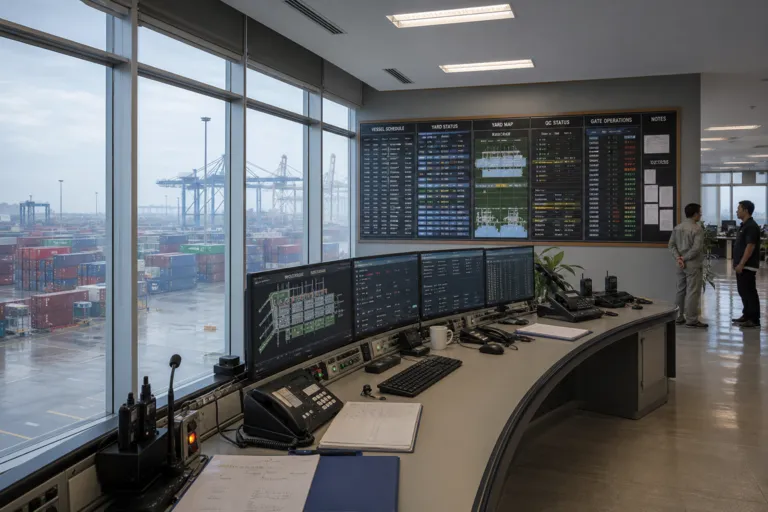
Vietnam’s push toward a more competitive transshipment role is increasingly tied to software, data, and automation—not only concrete and cranes. Vietnam’s Logistics Development Strategy mandates digital customs platforms, creating a policy pull for paperless processes across freight and logistics operations. At the same time, the Ministry of Industry and Trade has framed a new competitive landscape where data processing, AI, and automation matter as much as physical infrastructure, with companies accelerating the use of the Internet of Things (IoT), big data, and digital operational management systems. This shift is also happening alongside capacity growth and network expansion, so digital tools must scale with new routes, terminals, and inland connections.
In practice, digital systems are already cutting friction in cross-border trade. Vietnam Customs reported that the full rollout of the ASEAN single-window cut border paperwork by 30% and enabled 95% electronic submissions by 2024. The Dong Dang–Pingxiang crossing saw clearance trimmed to three hours, while risk-based inspections and non-intrusive scanners cleared 85% of containers without opening. These figures matter for ports because faster, more predictable border flows can change routing decisions and encourage relay movements across Southeast Asia. They also show why “smart” port development cannot stop at the quay; it depends on interoperable documentation, inspection, and tax assessment workflows.
Automation Moves From Back Office to the Yard
Digitization is also reshaping domestic logistics flows that feed ports and terminals. Domestic parcel volumes jumped 45% in 2024, and courier networks deployed automated sorters and AI route engines that reduced average delivery windows from 48 to 24 hours. ViettelPost opened 15 robotic sort centers, while providers worked to expand coverage and capacity for fast-growing e-commerce demand. In 2025, Vietnam’s e-commerce market reached USD 31 billion, accounting for nearly 10% of total retail sales and consumer service revenue and contributing approximately two-thirds of the country’s digital economy. For port ecosystems, these trends pull more cargo into time-sensitive, data-tracked networks where real-time visibility becomes a commercial requirement.
Port operators are pairing this digital momentum with expansion plans, while managing performance under uncertainty. In the first six months of 2026, Vietnam Maritime Corporation (VIMC) reported consolidated revenue of VND 13,483 billion (61% of the annual plan) and consolidated profit of VND 2,543 billion (79% of the 2026 plan). Over the same period, cargo throughput at ports reached 89.82 million tons (50% of the annual plan), and maritime transport volume reached 12.67 million tons (53% of the 2026 plan). VIMC is investing in container terminals No. 3 and No. 4 at Lach Huyen (Hai Phong city) and the Can Gio International Transshipment Port (Ho Chi Minh City), positioning infrastructure growth alongside operational solutions to maintain stable production and business activities.
New “smart logistics” models highlight what the next stage of Vietnam smart port digitalization can look like when terminals, security, and documentation become more automated. Vietnam SuperPort™—located on a northern logistics corridor connecting more than 20 industrial zones and extending to Yunnan and Kunming (China)—is described as one of the first models in Vietnam to experiment with “moving cargo terminals outside the airport,” potentially reducing cargo pressure at major airport terminals by about 25%. The project is also collaborating with Google, Kyndryl, and other technology partners to research integrating AI into security screening systems and automated document authentication to improve processing speed and enhance aviation logistics security. Across the wider market, the same logic applies: the winners in a transshipment future will be the operators that combine capacity with real-time optimization and end-to-end digital workflows.
What results show progress toward paperless trade flows in Vietnam?
How is automation changing delivery performance in Vietnam’s logistics networks?
Which port expansion projects is VIMC pursuing alongside operational improvements?
What does Vietnam SuperPort™ suggest about the next phase of Vietnam smart port digitalization?