
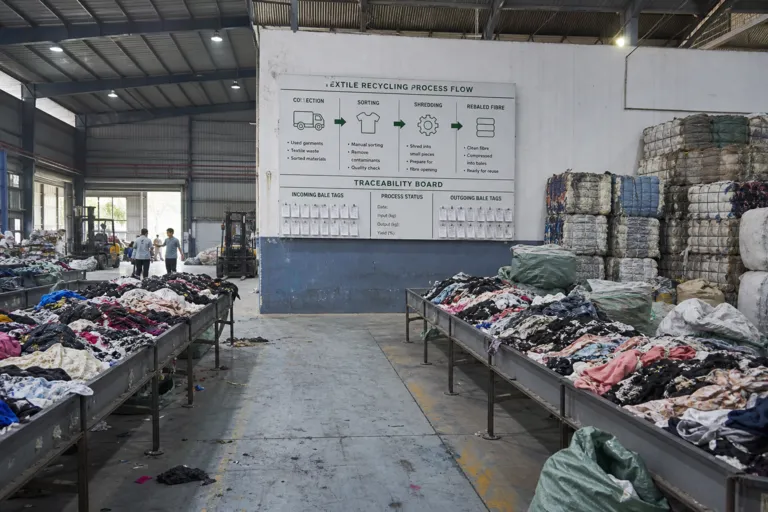
Vietnam’s garment and textile producers are being judged on more than cost and capacity. Buyers are tightening expectations around emissions, sustainability, traceability, and circularity, which is pushing suppliers to rethink what happens to fabric scraps and other waste streams. One 2026 study on Vietnam’s textile and apparel industry estimates the sector produces about 1.185 million tons of textile waste per year. At the same time, only about 5% of domestic factories are reported to meet EU-related sustainability standards, and only 18% of businesses are described as having completely embraced digital transformation. In this context, Vietnam textile recycling is no longer a side project. It is becoming a core capability for keeping orders and moving up the value chain.
Research focused on small and medium-sized enterprises in Vietnam’s fashion and textile industry highlights a central obstacle: the absence of formal domestic recycling and reverse logistics systems. Without organized take-back channels, sorting, and reliable pathways to recyclers, “readily available textile waste resources” are harder to use at scale. That same gap also signals opportunity. The study argues Vietnam could develop a new, high-value domestic circular industry if infrastructure and policy support improve. It also emphasizes that leadership commitment and business model innovation can enable circular economy adoption among Vietnamese SMEs. In practice, this means moving from informal, ad-hoc scrap handling to planned collection, processing, and resale systems that fit export-driven supply chains.
What Circular Fashion Supply Chains Require in Vietnam
Across the industry, circular supply chain transformation is framed as a way to reduce waste, improve material recovery, and strengthen traceability. Yet multiple sources describe the same friction points. Weak recycling and reverse logistics systems are repeatedly cited, alongside technology barriers and limited traceability capabilities that stop circular plans from becoming “real, tangible economic value.” Building stable demand also matters. Global Textile Times, citing Textile Exchange, says recycled fibers account for 7.6% of total global fiber production, or about 1 kilogram of recycled fiber for every 13 kilograms produced. It also reports global demand for recycled polyester fiber at 11.8%, while brands’ demand for recycled fibers used in their products can reach 76%, illustrating how buyer expectations can outpace supply availability and verification.
Export growth keeps the pressure on. Vietnam’s Ministry of Industry and Trade expects textile and garment exports to reach USD 46 billion in 2025, with the industry targeting USD 48 billion in 2026. By August 2026, export turnover had reached approximately USD 26.9 billion, up 1.6% from the same period last year. Buyer scrutiny is rising alongside those numbers. H&M’s CFO for Production China and Southeast Asia, Alen Wei, has said brands increasingly look for supply partners that can demonstrate sustainability, innovation, resilience, and long-term value creation in addition to pricing and quality. H&M has sourced from Vietnam for more than two decades and currently works with more than 40 suppliers operating over 70 factories and employing more than 60,000 workers in the country, making compliance signals from large buyers hard to ignore.
Investment signals are also shifting toward recycling-linked capacity. A market report describes the Vietnam Textile Manufacturing Market as worth USD 5.27 billion in 2026 and growing at a CAGR of 6.79% to reach USD 7.32 billion by 2031. It also notes Syre Group received an investment registration certificate for a USD 1 billion polyester recycling and fabric complex in Binh Dinh, with capacity up to 250,000 tons per year and a 2029 operating target. For manufacturers, the practical takeaway is that circularity requires more than marketing claims. It depends on data discipline, long-term linkage contracts, and data-sharing mechanisms that can build a stable recycled raw material market and credible traceability records.
How much textile waste does Vietnam’s textile and apparel industry produce each year?
What is the biggest barrier holding back Vietnam’s textile recycling and circular transition?
What do buyers increasingly require from Vietnamese suppliers beyond price and quality?
What major recycling investment has been reported for Vietnam?
How large is the reported gap between recycled polyester demand and brands’ recycled-fiber targets?