Vietnam’s macro numbers show momentum, but they also highlight a structural gap in how much value the local economy keeps. At a supply chain forum held on September 18, Dr. Pham Van Quan said nominal GDP in 2025 is projected at about USD 514 billion, with GDP per capita around USD 5,026. He also cited growth signals in 2026, including expected GDP growth of 8.18% in the first six months, and an Industrial Production Index increase of 11.9% in the first eight months, with manufacturing alone up 12.5%. Yet he stressed the harder question is quality: how to raise the value created and retained in Vietnam as global supply chains shift.
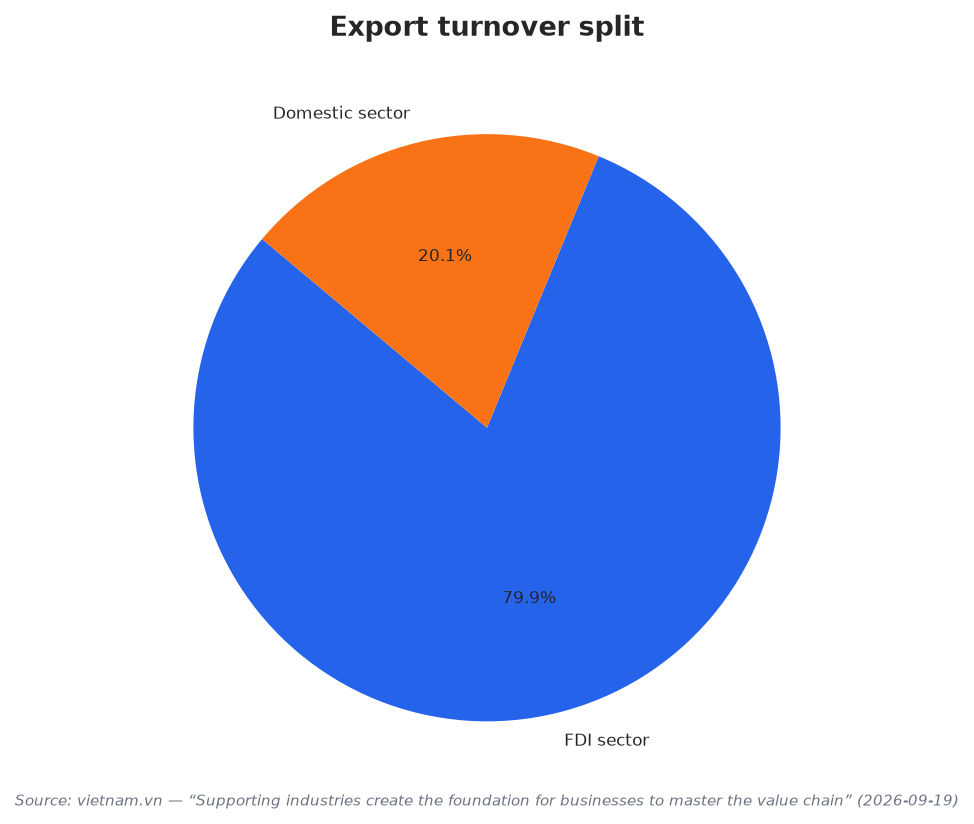
The localization gap shows up clearly in trade structure and where firms sit on the value chain. Dr. Quan said the FDI sector accounts for about 79.9% of total export turnover, while the domestic sector contributes about 20.1%. In the same discussion, he described Vietnamese enterprises as still concentrated in low value-added stages, with heavy dependence on imported raw materials, components, equipment, and core technologies. Processing and assembly remain common, while research and development and intellectual property capabilities are limited. This mix can attract orders, but it can also cap local learning and the ability to negotiate higher-value roles.
Why Localization Determines the Next Tier of FDI
Building capability in components, materials, and industrial inputs is presented as the direct lever for moving from “present in the chain” to “owning more stages.” In this context, Vietnam supporting industries matter because they can raise localization rates and help domestic firms become suppliers for multinational corporations operating in Vietnam. Dr. Quan outlined solution groups that need to move together: institutional reforms and improved policies, stronger linkages between FDI and domestic enterprises, technology transfer, and supplier networks that can meet international standards. He also emphasized that digital transformation and green transformation are becoming requirements for market access and a path to better productivity, quality, and efficiency.
Vietnam is also setting explicit localization targets through the Industrial Support Development Program for 2026–2035. The program aims for localization rates by 2030 of 30% in electronics, 40% in mechanics, 30% in automobiles, 60% in textiles, 65% in footwear, and 15% in high-tech industries. Alongside target-setting, it includes building a digital data platform for supply chain management and improving mechanisms to create markets for domestically produced products. The policy intent is clear: localization is not treated as a slogan, but as a measurable pathway into deeper value-chain positions.
FDI inflows remain strong, which raises the urgency of converting scale into deeper domestic capability. An article on creating an FDI ecosystem reported that in the first seven months of 2026, total registered FDI reached USD 38.1 billion and disbursed FDI reached USD 15.2 billion; it also reported export turnover of USD 319.5 billion and IIP growth of 11.4% in the same period. Another discussion on localization and South Korean capital said implementation of supporting-industry policies has been fragmented and has not formed a robust ecosystem for domestic firms to join FDI value chains. A ScienceDirect study adds an industry lens: in electronics, domestic production technology lags, reaching only 64% of FDI output, reinforcing the case that linkages and capability-building determine whether spillovers translate into upgrading.
What is the localization gap in Vietnam’s supply-chain participation?
How large is the export share of the FDI sector compared with the domestic sector?
What localization targets are set for 2030 under the support industry program?
How can Vietnam’s supporting industries help attract higher-value FDI?
What does the electronics case suggest about capability gaps?