Vietnam’s falling birth rate is now a headline demographic issue. Vietcetera reports the country’s fertility rate fell to a record low of 1.91 children per woman in 2024, below the replacement level of 2.1. Statista similarly places Vietnam’s 2024 total fertility rate at 1.9 children per woman. Vietcetera adds that birth rates are especially low in major cities, citing Ho Chi Minh City at 1.32 children per woman in 2023. These figures shape how policymakers and families think about timing, family size, and the growing role of fertility care in Vietnam.
Alongside these population trends, Vietnam’s IVF story has expanded quickly in clinical scale. VOV5.VN notes Vietnam’s first IVF case was in 1998, describing it as a breakthrough that helped catalyze broader growth in infertility treatment. The same source says tens of thousands of infertility cases are treated each year, and that more than 200,000 children were born thanks to IVF. Those milestones help explain why discussions about the Vietnam IVF fertility market often focus on service capacity, patient flow, and the breadth of procedures offered, not only on demographics.
Demand Signals: Demographics, Infertility, and Delayed Parenthood
While Vietnam-specific infertility prevalence is not quantified in the provided sources, broader benchmarks show why fertility services demand can rise even as births fall. The World Health Organization estimates that one in six people globally (17.5%) experience infertility, with comparable prevalence across regions, according to a fertility services market report. In Asia-Pacific context, Market Data Forecast cites a Lancet-referenced survey indicating infertility in China has climbed to approximately 18% among couples of childbearing age. Together, these figures provide context for how more couples may seek medical help to conceive, especially as social norms shift toward later parenthood.
Delayed family formation is repeatedly linked to higher need for medical intervention. Vietcetera reports surveys suggesting younger Vietnamese are increasingly delaying marriage and parenthood, and cites a Happiness Saigon finding that 75.9% of Gen Z respondents would rather establish a stable life with their partner before having children. Outside Vietnam, the same pattern is quantified: Market Research Future reports the mean age at first birth in the OECD reached 29.7 years in 2023, up from 26.9 in 2000. Market Data Forecast adds that Japan’s average age of first-time mothers rose to 31.0 years (as of 2023). These indicators matter because delayed timing can intensify fertility care demand, including IVF.
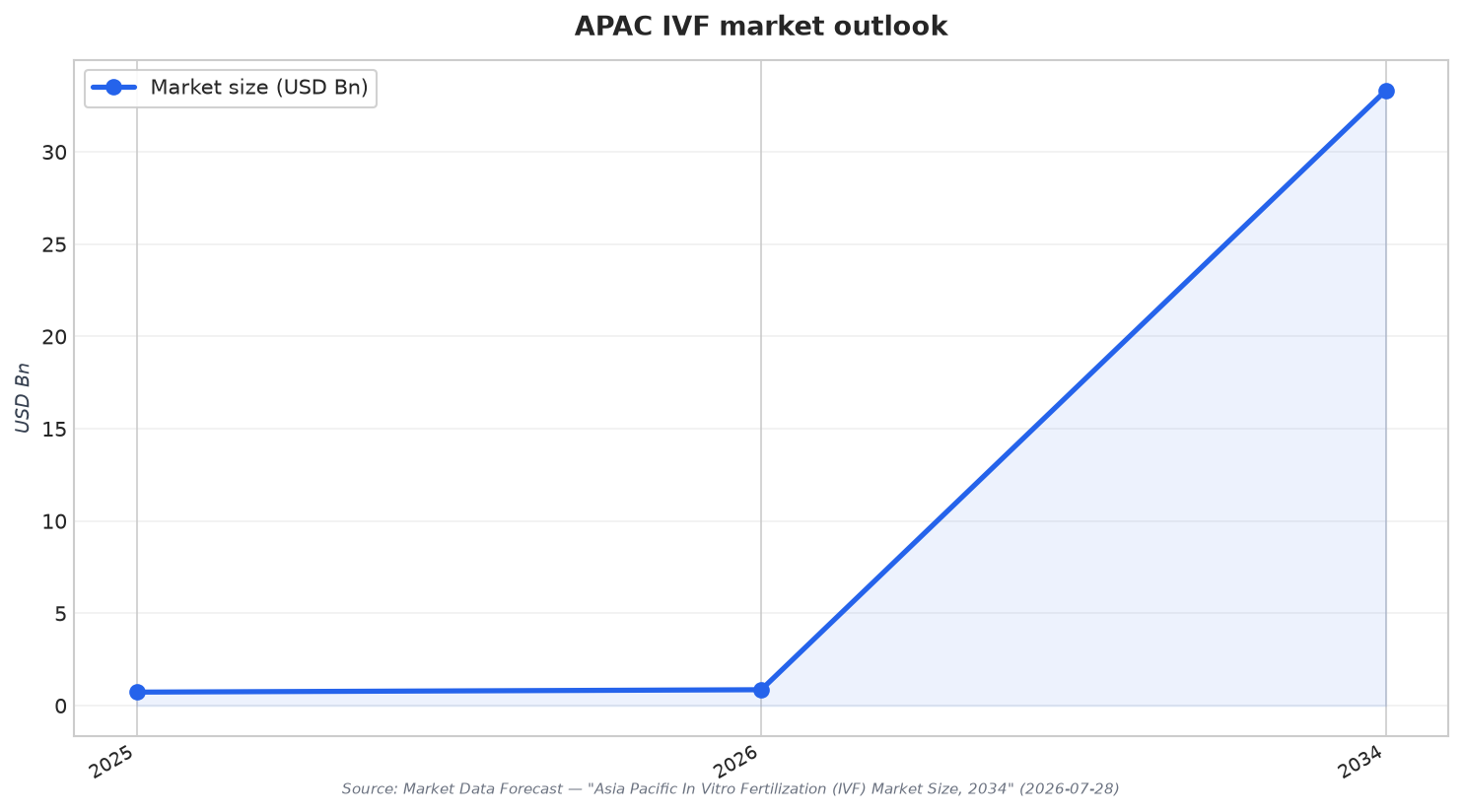
At the market level, Asia-Pacific forecasts suggest continued momentum for IVF services across the region, even though those numbers are not Vietnam-only. Market Data Forecast values the Asia Pacific IVF market at USD 0.73 billion in 2025 and estimates USD 0.86 billion in 2026, projecting USD 33.32 billion by 2034 at a CAGR of 18.4% from 2026 to 2034. For readers tracking Vietnam’s IVF fertility market, these regional figures are best read as a demand-and-investment backdrop. Locally, VOV5.VN’s report of tens of thousands of infertility cases treated per year and more than 200,000 IVF-born children since 1998 signals why service expansion and advanced procedures remain central to the conversation.
What is Vietnam’s fertility rate now, according to the sources?
How low is Ho Chi Minh City’s fertility rate?
How has IVF grown in Vietnam since it began?
What does the World Health Organization estimate about infertility prevalence?
What is driving attention to the Vietnam IVF fertility market right now?