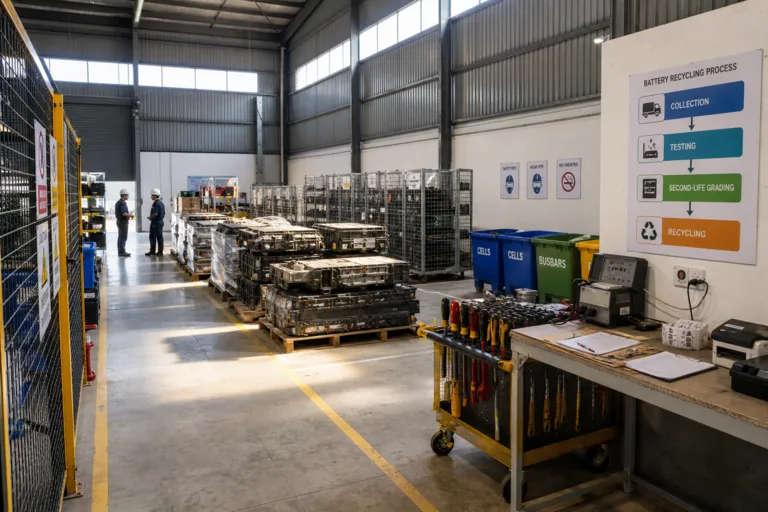
Vietnam’s battery story is quickly becoming a circular-economy story. The Vietnam Second Life Battery Market is valued at approximately USD 305 million to USD 420 million, based on current market analysis. Ken Research links this growth to renewable energy needs, an EV surge, and government policies that encourage sustainable energy practices and lower emissions. In this context, Vietnam EV battery recycling is not only about end-of-life treatment. It is also about managing batteries across a longer lifecycle, including second-life applications that can delay disposal and improve resource efficiency.
Energy storage targets create a direct use case for repurposed packs. Vietnam’s revised Power Development Plan VIII (PDP8) elevated earlier targets of just 300 MW of battery energy storage systems capacity to 10,000–16,300 MW by 2030. Ken Research also projects Vietnam’s domestic battery demand could reach 46.9 GWh by 2030, driven by approximately 1.55 million electric two-wheelers, 171,000 passenger electric vehicles, and deployment of 10,000 MW of battery energy storage systems. Those figures point to a future pipeline of batteries that will eventually need collection, grading, and either second-life reuse or recycling.
From Urban Demand to Regional Supply Chains
Industrial clustering matters because it shapes where batteries are sold, serviced, and later retired. Ken Research notes that key cities such as Ho Chi Minh City and Hanoi dominate the market due to rapid urbanization and industrial growth. It also states that northern hubs such as Hanoi and Hai Phong account for 65% of electronics production, and highlights Samsung’s USD 850 million battery component facility as an accelerator of regional demand. For industry builders, that concentration suggests practical starting points for reverse logistics: collection networks, test-and-grade facilities, and refurbishment lines can be anchored where electronics and EV-related activity already concentrates.
Second-life performance expectations help define what “good” looks like for refurbishment programs. A Market.us report cites World Resources Institute reporting in 2026 that EV batteries commonly retain 70% to 80% of original capacity at vehicle retirement. The same report cites a 2025 IEEE study finding second-life packs remain viable for low to medium demand storage over roughly 2,500 to 3,000 cycles. Those global reference points reinforce why testing and grading are central: matching residual capacity and cycle life to lower-stress stationary duty can extend value before final recycling. Separately, GlobeNewswire notes that recycling infrastructure for mixed battery chemistries remains underdeveloped in several markets, strengthening the case for standardized processes and coordinated lifecycle management.
Partnerships are already being used to turn policy intent into bankable execution. Ken Research points to PDP8 encouraging manufacturers to develop and market second-life battery solutions through strategic partnerships, including the VinES–Gotion joint venture and VinFast’s collaboration with India’s BatX Energies, framed around sustainable recycling and second-life applications. In parallel, global market signals show how quickly this segment is scaling: Market.us projects the global second-life EV battery market from USD 1.20 Billion in 2025 to USD 22.60 Billion by 2035 at a CAGR of 34.10%, with Asia Pacific holding a 43.00% share valued at USD 0.52 Billion. Vietnam can use these cues to prioritize practical building blocks—collection, diagnostics, refurbishment, and clear routes to recycling—so second life becomes an organized industry rather than an informal afterthought.
What is driving Vietnam’s move toward second-life batteries and recycling?
What storage targets under PDP8 support second-life battery use?
How much capacity can EV batteries retain when they retire from vehicles?
Why does standardization matter for Vietnam EV battery recycling and reuse?
Which Vietnam regions are highlighted as important for second-life battery demand and supply chains?